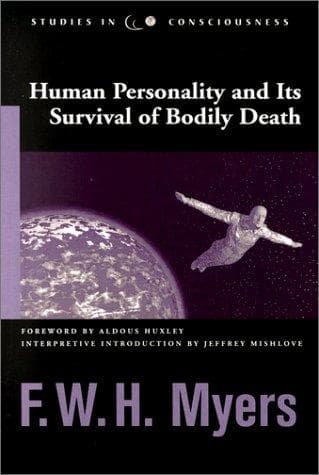
Human Personality and Its Survival of Bodily DeathMyers, F. W. H. (Frederic William Henry)
Religion
Human Personality and Its Survival of Bodily Death
Myers, F. W. H. (Frederic William Henry)
Immortality; Parapsychology; Personality
Looking at the matter from the evolutionary point of view, the question
among sensations was one of the development of the fittest; that is to
say that, as the organism became more complex and needed sensations more
definite than sufficed for the protozoon, certain sensibilities got
themselves defined and stereotyped upon the organism by the evolution of
end-organs.[80] Others failed to get thus externalised; but may, for
aught we know, persist nevertheless in the central organs;--say, for
instance, in what for man are the optic or olfactory tracts of the
brain. There will then be no apparent reason why these latent powers
should not from time to time receive sufficient stimulus, either from
within or from without, to make them perceptible to the waking
intelligence, or perceptible at least in states (like trance) of narrow
concentration.
As the result of these considerations, I approach alleged heteræsthesiæ
of various kinds with no presumption whatever against their real
occurrence. Yet on the other hand, my belief in the extent of possible
_hyperæsthesia_ continually suggests to me that the apparently new
perceptions may only consist of a mixture of familiar forms of
perception, pushed to a new extreme, and centrally interpreted with a
new acumen, while there is no doubt that many experiments supposed to
furnish evidence of such new perceptions merely illustrate the effect of
suggestion or self-suggestion.
Without, however, presuming to criticise past evidence wholesale, I yet
hope that the experience now attained may lead to a much greater number
of well-guarded experiments in the near future. In Appendix V.A, I very
briefly present the actual state of this inquiry. In default of any
logical principle, I shall there divide these alleged forms of
sensibility according as they are excited by inorganic objects on the
one hand, or by organisms (dead or living) on the other.
In the meantime I pass on to that group of the dynamogenic effects of
suggestion which affect the more central vital operations--either the
vaso-motor system, or the neuro-muscular system, or the central sensory
tracts. The effects of suggestion on character--induced changes to which
we can hardly guess the nervous concomitant--will remain to be dealt
with later.
Public-domain text, read in full here on John Shaqi.
Reviews
Reviews
No reviews yet
Be the first to share your thoughts on this work.
Elsewhere in the archive
Join the Discussion
Join the discussion
Sign in to leave a comment or review.
Sign InorCreate an account