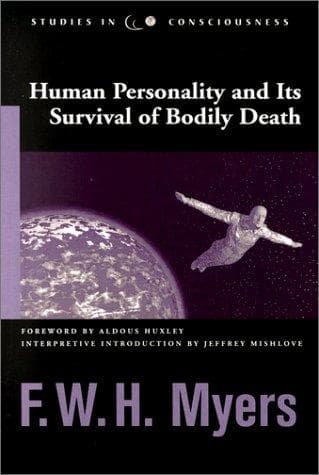
Human Personality and Its Survival of Bodily DeathMyers, F. W. H. (Frederic William Henry)
Religion
Human Personality and Its Survival of Bodily Death
Myers, F. W. H. (Frederic William Henry)
Immortality; Parapsychology; Personality
And now let us pass on from these specialised influences of suggestion
on certain kinds of attention to its influence on attention generally,
as needed, for instance, in education. If we can arrest the shifting of
the mental focus to undesired ideational centres in at all the same way
as we can arrest the choreic or fidgety shiftings of motor impulse to
undesired motor centres, we shall have done perhaps as much for the
world's ordinary work as if we had raised the average man's actual
intelligence a step higher in the scale. We shall have checked waste,
although we may not have improved quality. The well-known case of Dr.
Forel's warders,[87] who were enabled by hypnotic suggestion to sleep
soundly by the side of the patients they had to watch, and wake only
when the patients required to be restrained, shows us how by this means
the attention may be concentrated on selected impressions and waste of
energy be avoided in a way that could hardly be compassed by any
ordinary exercise of the will.
How far, indeed, we can go in actually _heightening_ intelligence by
suggestion we have yet to learn. We must not expect to add a cubit to
intellectual any more than to physical stature. Limitations at birth
must prevent our developing the common man into a Newton; but there
seems no reason why we should not bring up his practical achievements
much nearer than at present to the maximum of his innate capacity.[88]
In passing on from the influence of suggestion on _attention_ to its
influence on _will_, I am not meaning to draw any but the most every-day
distinction between these two forms of inward concentration. The point,
in fact, which I wish now to notice is rather a matter of common
observation than a provable and measurable phenomenon. I speak of the
energy and resolution with which a hypnotic suggestion is carried
out;--the _ferocity_, even, with which the entranced subject pushes
aside the opposition of much more powerful men. I do not, indeed, assert
that he would thus risk very serious injury; for I believe (with
Bramwell and others) that there does exist somewhere within him a
knowledge that the whole proceeding is a mere experiment. But,
nevertheless, he actually risks something; he behaves, in short, as a
confident, resolute man would behave, and this however timid and
unaggressive his habitual character may be. I believe that much
advantage may yet be drawn from this confident temper. We can thus
inhibit the acquired self-distrust and shyness of the supraliminal self,
and get the subliminal self concentrated upon some task which may be as
difficult as we please;--which may, if we can adjust it rightly, draw
out to the uttermost the innate powers of man.
Public-domain text, read in full here on John Shaqi.
Reviews
Reviews
No reviews yet
Be the first to share your thoughts on this work.
Elsewhere in the archive
Join the Discussion
Join the discussion
Sign in to leave a comment or review.
Sign InorCreate an account