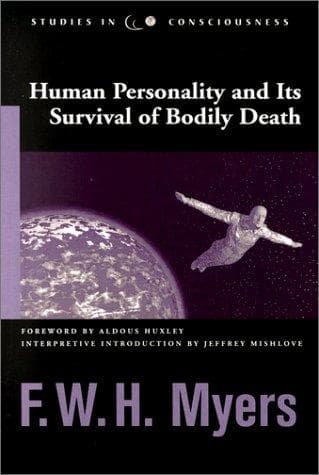
Human Personality and Its Survival of Bodily DeathMyers, F. W. H. (Frederic William Henry)
Religion
Human Personality and Its Survival of Bodily Death
Myers, F. W. H. (Frederic William Henry)
Immortality; Parapsychology; Personality
Dr. Milne Bramwell's experiments[85] (to mention these as a sample of
the rest) were post-hypnotic suggestions involving arithmetical
calculations; the entranced subject, for instance, being told to make a
cross when 20,180 minutes had elapsed from the moment of the order.
Their primary importance lay in showing that a subliminal or hypnotic
memory persisted across the intervening gulf of time,--days and nights
of ordinary life,--and prompted obedience to the order when at last it
fell due. But incidentally, as I say, it became clear that the subject,
whose arithmetical capacity in common life was small, worked out these
sums subliminally a good deal better than she could work them out by her
normal waking intelligence.
Of course, all that was needed for such simple calculations was close
attention to easy rules; but this was just what the waking mind was
unable to give, at least without the help of pencil and paper. If we lay
this long and careful experiment side by side with the accounts already
given of the solution of problems in somnambulic states, it seems clear
that there is yet much to be done in the education of subliminal memory
and acumen as a help to supraliminal work.
Important in this connection is Dr. Dufay's account of help given to an
actress in the representation of her _rôles_ by hypnotisation.[86] It
seems obvious that stage-fright is just the kind of nervous annoyance
from which hypnotisation should give relief. Somewhat similarly I
believe some persons can secure a cheap substitute for genius on stage
or platform, evoking by suggestion or self-suggestion a helpful
subliminal uprush. Here again, the hypnotisation is a kind of extension
of "secondary automatism,"--of the familiar lapse from ordinary
consciousness of movements (walking, pianoforte-playing, etc.), which
have been very frequently performed. The possibilities thus opened up
are very great: no less than the combination by mankind of the stability
of instinct with the plasticity of reason. There seems no reason why
man's range of automatism should not thus be largely increased in two
main ways: many things now unpleasant to do might be done with
indifference, and many things now difficult to do might be done with
ease.
Public-domain text, read in full here on John Shaqi.
Reviews
Reviews
No reviews yet
Be the first to share your thoughts on this work.
Elsewhere in the archive
Join the Discussion
Join the discussion
Sign in to leave a comment or review.
Sign InorCreate an account