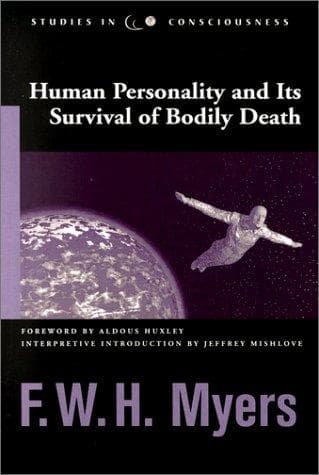
Human Personality and Its Survival of Bodily DeathMyers, F. W. H. (Frederic William Henry)
Religion
Human Personality and Its Survival of Bodily Death
Myers, F. W. H. (Frederic William Henry)
Immortality; Parapsychology; Personality
I know not how much of originality or importance may be attributed by
subsequent students of the subject to the step next in order in this
series of approximations. To those immediately concerned, the feeling of
a new departure was inevitably given by the very smallness of the
support which they for a long time received, and by the difficulty
which they found in making their point of view intelligible to the
scientific, to the religious, or even to the spiritualistic world. In
about 1873--at the crest, as one may say, of perhaps the highest wave of
materialism which has ever swept over these shores--it became the
conviction of a small group of Cambridge friends that the deep questions
thus at issue must be fought out in a way more thorough than the
champions either of religion or of materialism had yet suggested. Our
attitudes of mind were in some ways different; but to myself, at least,
it seemed that no adequate attempt had yet been made even to determine
whether anything could be learnt as to an unseen world or no; for that
if anything were knowable about such a world in such fashion that
Science could adopt and maintain that knowledge, it must be discovered
by no analysis of tradition, and by no manipulation of metaphysics, but
simply by experiment and observation;--simply by the application to
phenomena within us and around us of precisely the same methods of
deliberate, dispassionate, exact inquiry which have built up our actual
knowledge of the world which we can touch and see. I can hardly even now
guess to how many of my readers this will seem a truism, and to how many
a paradox. Truism or paradox, such a thought suggested a kind of effort,
which, so far as we could discover, had never yet been made. For what
seemed needful was an inquiry of quite other scope than the mere
analysis of historical documents, or of the _origines_ of any alleged
revelation in the past. It must be an inquiry resting primarily, as all
scientific inquiries in the stricter sense now must rest, upon objective
facts actually observable, upon experiments which we can repeat to-day,
and which we may hope to carry further to-morrow. It must be an inquiry
based, to use an old term, on the uniformitarian hypothesis; on the
presumption, that is to say, that _if a spiritual world exists, and if
that world has at any epoch been manifest or even discoverable, then it
ought to be manifest or discoverable now_.
Public-domain text, read in full here on John Shaqi.
Reviews
Reviews
No reviews yet
Be the first to share your thoughts on this work.
Join the Discussion
Join the discussion
Sign in to leave a comment or review.
Sign InorCreate an account