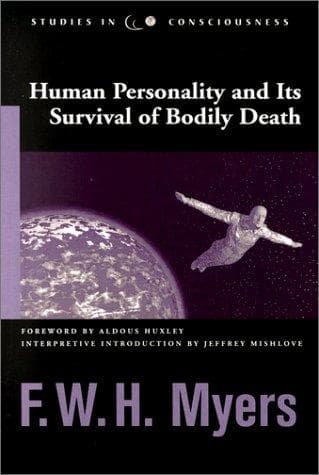
Human Personality and Its Survival of Bodily DeathMyers, F. W. H. (Frederic William Henry)
Religion
Human Personality and Its Survival of Bodily Death
Myers, F. W. H. (Frederic William Henry)
Immortality; Parapsychology; Personality
If this be the case, it seems likely that central perception will shape
itself on the types of perception to which the central tracts of the
brain are accustomed; and that the _connaissance supérieure_, the
telæsthetic knowledge, however it may really be acquired, will present
itself mainly as clairvoyance or clairaudience--as some form of sight or
sound. Yet these telæsthetic sights and sounds may be expected to show
some trace of their unusual origin. They may, for instance, be
_imperfectly co-ordinated_ with sights and sounds arriving through
external channels; and, since they must in some way be a translation of
supernormal impressions into sensory terms, they are likely to show
something _symbolic_ in character.
This tendency to subliminal symbolism, indeed, meets us at each point of
our inquiry. As an instance of it in its simplest form, I may mention a
case where a botanical student passing inattentively in front of the
glass door of a restaurant thought that he had seen _Verbascum Thapsus_
printed thereon. The real word was _Bouillon_; and that happens to be
the trivial name in French for the plant Verbascum Thapsus. The actual
optical perception had thus been subliminally transformed; the words
Verbascum Thapsus were the report to the inattentive supraliminal self
by a subliminal self more interested in botany than in dinner.
Nay, we know that our own optical perception is in its own way highly
symbolic. The scene which the baby sees instinctively,--which the
impressionist painter manages to see by a sort of deliberate
self-simplification,--is very different from the highly elaborate
interpretation and selection of blotches of colour by which the ordinary
adult figures to himself the visible world.
Now we adults stand towards this subliminal symbolism in much the same
attitude as the baby stands towards our educated optical symbolism. Just
as the baby fails to grasp the third dimension, so may we still be
failing to grasp a fourth;--or whatever be the law of that higher
cognisance which begins to report fragmentarily to man that which his
ordinary senses cannot discern.
Assuredly then we must not take the fact that any knowledge comes to us
symbolically as a proof that it comes to us from a mind outside our own.
The symbolism may be the inevitable language in which one stratum of our
personality makes its report to another. The symbolism, in short, may be
either the easiest, or the only possible psychical record of actual
objective fact; whether that fact be in the first instance discerned by
our deeper selves, or be conveyed to us from other minds in this
form;--elaborated for our mind's digestion, as animal food has been
elaborated for our body's digestion, from a primitive crudity of things.
Public-domain text, read in full here on John Shaqi.
Reviews
Reviews
No reviews yet
Be the first to share your thoughts on this work.
Elsewhere in the archive
Join the Discussion
Join the discussion
Sign in to leave a comment or review.
Sign InorCreate an account