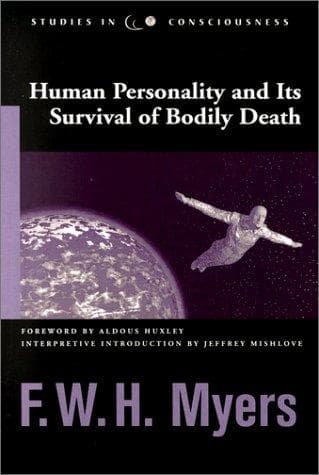
Human Personality and Its Survival of Bodily DeathMyers, F. W. H. (Frederic William Henry)
Religion
Human Personality and Its Survival of Bodily Death
Myers, F. W. H. (Frederic William Henry)
Immortality; Parapsychology; Personality
But again one must question, on general idealistic principles, whether
there be in such cases any real distinction between symbolism and
reality,--between subjective and objective as we commonly use those
terms. The resisting matter which we see and touch has "solid" reality
for minds so constituted as to have the same subjective feeling awakened
by it. But to other minds, endowed with other forms of
sensibility--minds possibly both higher and more numerous than our
own--this solid matter may seem disputable and unreal, while thought and
emotion, perceived in ways unknown to us, may be the only reality.
This material world constitutes, in fact, a "privileged case"--a
simplified example--among all discernible worlds, so far as the
perception of incarnate spirits is concerned. For discarnate spirits it
is no longer a privileged case; to _them_ it is apparently easier to
discern thoughts and emotions by non-material signs.[116] But they need
not therefore be wholly cut off from discerning material things, any
more than incarnate spirits are wholly cut off from discerning
immaterial things--thoughts and emotions symbolised in phantasmal form.
"The ghost in man, the ghost that once was man," to use Tennyson's
words, have each of them to overcome by empirical artifices certain
difficulties which are of different type for each, but are not
insurmountable by either.
These reflections, applicable at various points in our argument, have
seemed specially needed when we had first to attack the meaning of the
so-called "travelling clairvoyance," of which instances were given in
the chapter on hypnotism. It was needful to consider how far there was a
continuous transition between these excursions and directer
transferences between mind and mind,--between telæsthesia and telepathy.
It now seems to me that such a continuous transition may well exist, and
that there is no absolute gulf between the supernormal perception of
ideas as existing in other minds, and the supernormal perception of what
we know as matter. All matter may, for aught we know, exist as an idea
in some cosmic mind, with which mind each individual spirit may be in
relation, as fully as with individual minds. The difference perhaps lies
rather in the fact that there may be generally a _summons_ from a
cognate mind which starts the so-called agent's mind into action; his
invasion may be in some way _invited_; while a spiritual excursion among
inanimate objects only may often lack an impulse to start it. If this be
so, it would explain the fact that such excursions have mainly succeeded
under the influence of hypnotic suggestion.
Public-domain text, read in full here on John Shaqi.
Reviews
Reviews
No reviews yet
Be the first to share your thoughts on this work.
Elsewhere in the archive
Join the Discussion
Join the discussion
Sign in to leave a comment or review.
Sign InorCreate an account