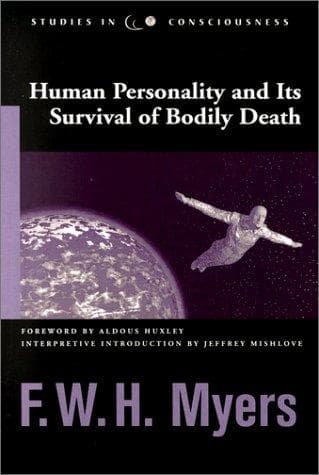
Human Personality and Its Survival of Bodily DeathMyers, F. W. H. (Frederic William Henry)
Religion
Human Personality and Its Survival of Bodily Death
Myers, F. W. H. (Frederic William Henry)
Immortality; Parapsychology; Personality
With this again may be compared a case in _Phantasms of the Living_
(vol. ii. p. 368), where a dreamer seems to himself to be present in the
Thames Tunnel during a fatal accident, which did in fact occur during
that night. Here again the drowned workman--who was quite unknown to the
distant dreamer--can hardly be called an _agent_; yet it may have been
the excitement surrounding his death which attracted the dreamer's
spirit to that scene, as a conflagration might attract a waking
night-wanderer.
There are, on the other hand, a good many cases where a scene thus
discerned in a flash is one of special interest to the percipient,
although no one in the scene may have actually wished to transfer it to
him.
A case again of a somewhat different type is the sudden waking vision of
Mr. Gottschalk,[118] who sees in a circle of light the chalked hands and
ruffled wrists of Mr. Courtenay Thorpe--a well-known actor--who was
opening a letter of Mr. Gottschalk's in that costume at the time.
Trivial in itself, this incident illustrates an interesting class of
cases, where a picture very much like a crystal-vision suddenly appears
on a wall or even in the air with no apparent background.
I know one or two persons who have had in their lives one single round
or oval hallucinatory picture of this kind, of which no interpretation
was apparent,--a curious indication of some subliminal predisposition
towards this somewhat elaborate form of message.
Somewhat like Mr. Gottschalk's projection of his picture upon a
background of dark air is the experience of Mrs. Taunton.[119] In this
case the phantasm was perfectly external; yet it certainly did not hold
to the real objects around the same relation as a figure of flesh and
blood would have held; it was in a peculiar way transparent. Gurney
regards this transparency as indicating _imperfect externalisation_ of
the hallucinatory image.
My own phrase, "imperfect _co-ordination_ of inner with outward vision,"
comes to much the same thing, and seems specially applicable to Mrs.
Taunton's words: "The appearance was not transparent or filmy, but
perfectly solid-looking; _and yet I could somehow see the orchestra, not
through, but behind it_." There are a few cases where the percipient
seems to see a hallucinatory figure _behind_ him, out of the range of
optical vision.[120] There is of course no reason why this should not be
so,--even if a part of space external to the percipient's brain should
be actually affected.
Mr. Searle's case also is very interesting.[121] Here Mrs. Searle faints
when visiting a house a few miles from Mr. Searle's chambers in the
Temple. At or about the same time, he sees as though in a looking-glass,
upon a window opposite him, his wife's head and face, white and
bloodless.
Gurney suggests that this was a transference from Mrs. Searle's mind
simply of "the _idea_ of fainting," which then worked itself out into
perception in an appropriate fashion.
Public-domain text, read in full here on John Shaqi.
Reviews
Reviews
No reviews yet
Be the first to share your thoughts on this work.
Elsewhere in the archive
Join the Discussion
Join the discussion
Sign in to leave a comment or review.
Sign InorCreate an account