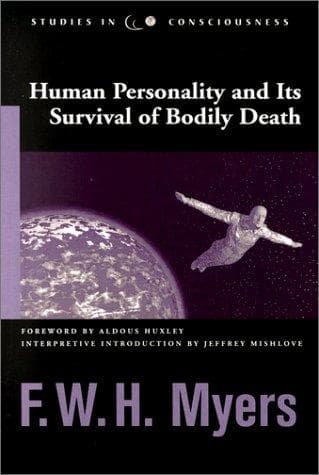
Human Personality and Its Survival of Bodily DeathMyers, F. W. H. (Frederic William Henry)
Religion
Human Personality and Its Survival of Bodily Death
Myers, F. W. H. (Frederic William Henry)
Immortality; Parapsychology; Personality
Twenty years ago [abroad] I had a patient, wife of a parson. She
had a peculiar kind of delirium which did not belong to her
disease, and perplexed me. The house in which she lived was closed
at midnight, that is--the outer door had no bell. One night I saw
her at nine. When I came home I said to my wife, "I don't
understand that case; I wish I could get into the house late." We
went to bed rather early. At about one o'clock I got up. She said,
"What are you about? are you not well?" I said, "Perfectly so."
"Then why get up?" "Because I can get into that house." "How, if it
is shut up?" "I see the proprietor standing under the lamp-post
this side of the bridge, with another man." "You have been
dreaming." "No, I have been wide awake; but dreaming or waking, I
mean to try." I started with the firm conviction that I should find
the individual in question. Sure enough there he was under the
lamp-post, talking to a friend. I asked him if he was going home.
(I knew him very well.) He said he was, so I told him I was going
to see a patient, and would accompany him. I was positively ashamed
to explain matters; it seemed so absurd that I knew he would not
believe me. On arriving at the house I said, "Now I am here, I will
drop in and see my patient." On entering the room I found the maid
giving her a tumbler of strong grog. The case was clear; it was as
I suspected--delirium from drink. The next day I delicately spoke
to the husband about it. He denied it, and in the afternoon I
received a note requesting me not to repeat the visits. Three weeks
ago I was recounting the story and mentioned the name. A lady
present said: "That is the name of the clergyman in my parish, at
B., and his wife is in a lunatic asylum from drink!"
In conversation with Gurney, the narrator explained that the
vision--though giving an impression of externality and seen, as he
believes, with open eyes--was not definably located in space. He had
never encountered the proprietor in the spot where he saw him, and it
was not a likely thing that he should be standing talking in the streets
at so late an hour.
In this case we cannot consider either the drunken patient or the
indifferent proprietor as in any sense the _agent_. Somehow or other the
physician's own persistent wish to get some such opportunity induced a
collaboration of his subliminal with his supraliminal self, akin to the
inspirations of genius. Genius, however, operates within ordinary
sensory limits; while in this physician's case the subliminal self
exercised its farthest-reaching supernormal powers.
Public-domain text, read in full here on John Shaqi.
Reviews
Reviews
No reviews yet
Be the first to share your thoughts on this work.
Elsewhere in the archive
Join the Discussion
Join the discussion
Sign in to leave a comment or review.
Sign InorCreate an account