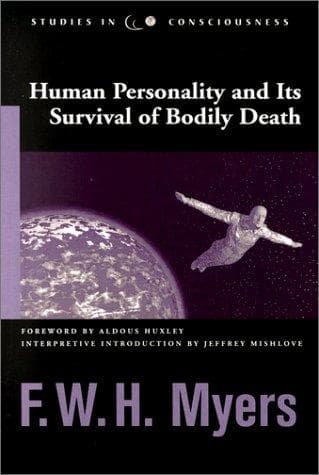
Human Personality and Its Survival of Bodily DeathMyers, F. W. H. (Frederic William Henry)
Religion
Human Personality and Its Survival of Bodily Death
Myers, F. W. H. (Frederic William Henry)
Immortality; Parapsychology; Personality
In these self-projections we have before us, I do not say the most
useful, but the most extraordinary achievement of the human will. What
can lie further outside any known capacity than the power to cause a
semblance of oneself to appear at a distance? What can be a more
_central_ action--more manifestly the outcome of whatsoever is deepest
and most unitary in man's whole being? Here, indeed, begins the
justification of the conception expressed at the beginning of this
chapter;--that we should now see the subliminal self no longer as a mere
chain of eddies or backwaters, in some way secluded from the main stream
of man's being, but rather as itself the central and potent current, the
most truly identifiable with the man himself. Other achievements have
their manifest limit; where is the limit here? The spirit has shown
itself in part dissociated from the organism; to what point may its
dissociation go? It has shown some independence, some intelligence, some
permanence. To what degree of intelligence, independence, permanence,
may it conceivably attain? Of all vital phenomena, I say, this is the
most significant; this self-projection is the one definite act which it
seems as though a man might perform equally well before and after bodily
death.
CHAPTER VII
PHANTASMS OF THE DEAD
οὑκἑτι πρὁσω
ἁβἁταν ἁλα κιὁνων ὑπἑρ Ἡρακλἑος περἁν εὑμαρἑς.
...θυμἑ, τἱνα πρὁς ἁλλοδαπἁν
ἁκραν ἑμὁν πλὁον παραμειβεαι;
--PINDAR
The course of our argument has gradually conducted us to a point of
capital importance. A profound and central question, approached in
irregular fashion from time to time in previous chapters, must now be
directly faced. From the actions and perceptions of spirits still in the
flesh, and concerned with one another, we must pass on to inquire into
the actions of spirits no longer in the flesh, and into the forms of
perception with which men still in the flesh respond to that unfamiliar
and mysterious agency.
Public-domain text, read in full here on John Shaqi.
Reviews
Reviews
No reviews yet
Be the first to share your thoughts on this work.
Elsewhere in the archive
Join the Discussion
Join the discussion
Sign in to leave a comment or review.
Sign InorCreate an account