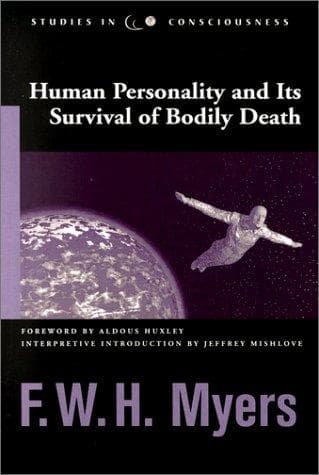
Human Personality and Its Survival of Bodily DeathMyers, F. W. H. (Frederic William Henry)
Religion
Human Personality and Its Survival of Bodily Death
Myers, F. W. H. (Frederic William Henry)
Immortality; Parapsychology; Personality
There need, I hope, be no real break here in my previous line of
argument. The subliminal self, which we have already traced through
various phases of growing sensitivity, growing independence of organic
bonds, will now be studied as sensitive to yet remoter influences;--as
maintaining an independent existence even when the organism is
destroyed. Our subject will divide itself conveniently under three main
heads. _First_, it will be well to discuss briefly the nature of the
evidence to man's survival of death which may theoretically be
obtainable, and its possible connections with evidence set forth in
previous chapters. _Secondly_,--and this must form the bulk of the
present chapter,--we need a classified exposition of the main evidence
to survival thus far obtained;--so far, that is to say, as sensory
automatism--audition or apparition--is concerned; for motor
automatism--automatic writing and trance-utterance--must be left for
later discussion. _Thirdly_, there will be need of some consideration of
the meaning of this evidence as a whole, and of its implications alike
for the scientific and for the ethical future of mankind. Much more,
indeed, of discussion (as well as of evidence) than I can furnish will
be needed before this great conception can be realised or argued from
with the scientific thoroughness due to its position among fundamental
cosmical laws. Considering how familiar the notion--the vague shadowy
notion--of "immortality" has always been, it is strange indeed that so
little should have been done in these modern days to grasp or to
criticise it;--so little, one might almost say, since the _Phædo_ of
Plato.
Beginning, then, with the inquiry as to what kind of evidence ought to
be demanded for human survival, we are met first by the bluff statement
which is still often uttered even by intelligent men, that _no_ evidence
would convince them of such a fact; "neither would they be persuaded
though one rose from the dead."
Extravagant as such a profession sounds, it has a meaning which we shall
do well to note. These resolute antagonists mean that no new evidence
can carry conviction to them unless it be _continuous_ with old
evidence; and that they cannot conceive that evidence to a world of
spirit can possibly be continuous with evidence based upon our
experience of a world of matter. I agree with this demand for
continuity; and I agree also that the claims usually advanced for a
spiritual world have not only made no attempt at continuity with known
fact, but have even ostentatiously thrown such continuity to the winds.
The popular mind has expressly desired something startling, something
outside Law and above Nature. It has loved, if not a _Credo quia
absurdum_, at least a _Credo quia non probatum_. But the inevitable
retribution is a deep insecurity in the conviction thus attained.
Unsupported by the general fabric of knowledge, the act of faith seems
to shrink into the background as that great fabric stands and grows.
Public-domain text, read in full here on John Shaqi.
Reviews
Reviews
No reviews yet
Be the first to share your thoughts on this work.
Elsewhere in the archive
Join the Discussion
Join the discussion
Sign in to leave a comment or review.
Sign InorCreate an account