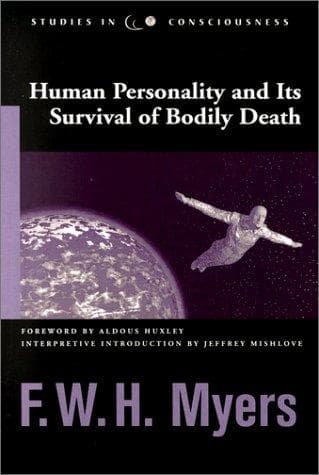
Human Personality and Its Survival of Bodily DeathMyers, F. W. H. (Frederic William Henry)
Religion
Human Personality and Its Survival of Bodily Death
Myers, F. W. H. (Frederic William Henry)
Immortality; Parapsychology; Personality
I can hardly too often repeat that my object in these pages is of a
quite opposite character. Believing that all cognisable Mind is as
continuous as all cognisable Matter, my ideal would be to attempt for
the realm of mind what the spectroscope and the law of gravitation have
effected for the realm of matter, and to carry that known cosmic
uniformity of substance and interaction upwards among the essences and
operations of an unknown spiritual world. And in order to explore these
unreachable altitudes I would not ask to stand with the theologian on
the summit of a "cloud-capt tower," but rather on plain earth at the
measured base of a trigonometrical survey.
If we would measure such a base, the jungle must be cleared to begin
with. Let us move for a while among first definitions; trying to make
clear to ourselves what kind of thing it is that we are endeavouring to
trace or discover. In popular parlance, we are looking out for _ghosts_.
What connotation, then, are we to give to the word "ghost"--a word
which has embodied so many unfounded theories and causeless fears? It
would be more satisfactory, in the present state of our knowledge,
simply to collect facts without offering speculative comment. But it
seems safer to begin by briefly pointing out the manifest errors of the
traditional view; since that tradition, if left unnoticed, would remain
lodged in the background even of many minds which have never really
accepted it.
Briefly, then, the popular view regards a "ghost" as a _deceased person
permitted by Providence to hold communication with survivors_. And this
short definition contains, I think, at least three unwarrantable
assumptions.
In the first place, such words as _permission_ and _Providence_ are
simply neither more nor less applicable to this phenomenon than to any
other. We conceive that all phenomena alike take place in accordance
with the laws of the universe, and consequently by permission of the
Supreme Power in the universe. Undoubtedly the phenomena with which we
are dealing are in this sense permitted to occur. But there is no _a
priori_ reason whatever for assuming that they are permitted in any
especial sense of their own, or that they form exceptions to law,
instead of being exemplifications of law. Nor is there any _a
posteriori_ reason for supposing any such inference to be deducible from
a study of the phenomena themselves. If we attempt to find in these
phenomena any poetical justice or manifest adaptation to human cravings,
we shall be just as much disappointed as if we endeavoured to find a
similar satisfaction in the ordinary course of terrene history.
Public-domain text, read in full here on John Shaqi.
Reviews
Reviews
No reviews yet
Be the first to share your thoughts on this work.
Elsewhere in the archive
Join the Discussion
Join the discussion
Sign in to leave a comment or review.
Sign InorCreate an account