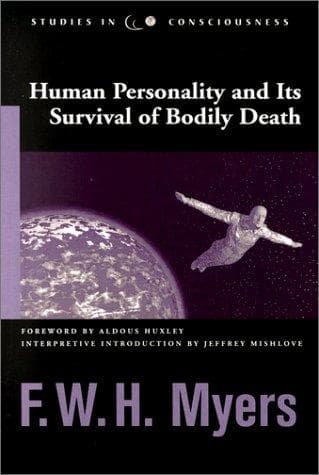
Human Personality and Its Survival of Bodily DeathMyers, F. W. H. (Frederic William Henry)
Religion
Human Personality and Its Survival of Bodily Death
Myers, F. W. H. (Frederic William Henry)
Immortality; Parapsychology; Personality
Let us next consider what types of communication from the dead our
existing evidence of communications among the living suggests to us as
analogically possible. It appears to me that there is an important
parallelism running through each class of our experiments in automatism
and each class of our spontaneous phenomena. Roughly speaking, we may
say that our experiment and observation up to this point have comprised
five different stages of phenomena, viz., (I.) hypnotic suggestion;
(II.) telepathic experiments; (III.) spontaneous telepathy during life;
(IV.) phantasms at death; (V.) phantasms after death. And we find, I
think, that the same types of communication meet us at each stage; so
that this recurrent similarity of types raises a presumption that the
underlying mechanism of manifestation at each stage may be in some way
similar.
Again using a mere rough form of division, we shall find three main
forms of manifestation at each stage: (1) hallucinations of the senses;
(2) emotional and motor impulses; (3) definite intellectual messages.
(I.) And first let us start from a class of experiments into which
telepathy does not enter, but which exhibit in its simplest form the
mechanism of the automatic transfer of messages from one stratum to
another of the same personality. I speak, of course, of post-hypnotic
suggestions. Here the agent is a living man, operating in an ordinary
way, by direct speech. The unusual feature lies in the condition of the
percipient, who is hypnotised at the time, and is thus undergoing a kind
of dislocation of personality, or temporary upheaval of a habitually
subjacent stratum of the self. This hypnotic personality, being for the
time at the surface, receives the agent's verbal suggestion, of which
the percipient's waking self is unaware. Then afterwards, when the
waking self has resumed its usual upper position, the hypnotic self
carries out at the stated time the given suggestion,--an act whose
origin the upper stratum of consciousness does not know, but which is in
effect a message communicated to the upper stratum from the now
submerged or subconscious stratum on which the suggestion was originally
impressed.
And this message may take any one of the three leading forms mentioned
above;--say a hallucinatory image of the hypnotiser or of some other
person; or an impulse to perform some action; or a definite word or
sentence to be written automatically by the waking self, which thus
learns what order has been laid upon the hypnotic self while the waking
consciousness was in abeyance.
Public-domain text, read in full here on John Shaqi.
Reviews
Reviews
No reviews yet
Be the first to share your thoughts on this work.
Elsewhere in the archive
Join the Discussion
Join the discussion
Sign in to leave a comment or review.
Sign InorCreate an account