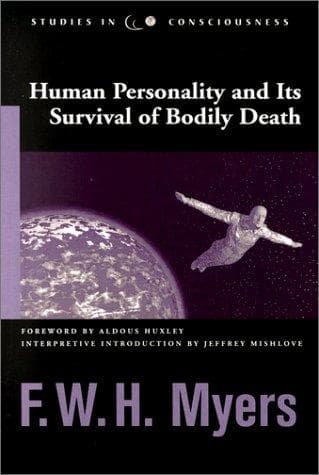
Human Personality and Its Survival of Bodily DeathMyers, F. W. H. (Frederic William Henry)
Religion
Human Personality and Its Survival of Bodily Death
Myers, F. W. H. (Frederic William Henry)
Immortality; Parapsychology; Personality
(IV.) Passing on to phantasms which cluster about the moment of death,
we find our three main classes of cases still meeting us. Our readers
are familiar with the _visual_ cases, where there is an actual
apparition of the dying man, seen by one or more persons; and also with
the _emotional and motor_ cases, where the impression, although
powerful, is not definitely sensory in character. And various cases also
have been published where the message has consisted of definite words,
not always externalised as an auditory hallucination, but sometimes
automatically _uttered_ or automatically _written_ by the percipient
himself, as in the case communicated by Dr. Liébeault (see Appendix
VIII. C), where a girl writes the message announcing her friend's death
at the time when that friend is, in fact, dying in a distant city.
(V.) And now I maintain that in these post-mortem cases also we find the
same general classes persisting, and in somewhat the same proportion.
Most conspicuous are the actual _apparitions_, with which, indeed, the
following pages will mainly deal. It is very rare to find an apparition
which seems to impart any verbal message; but a case of this kind has
been given in Appendix IV. F. As a rule, however, the apparition is of
the apparently automatic, purposeless character, already so fully
described. We have also the _emotional and motor_ class of post-mortem
cases;[131] and these may, perhaps, be more numerous in proportion than
our collection would indicate; for it is obvious that impressions which
are so much less definite than a visual hallucination (although they may
be even more impressive to the percipient himself) can rarely be used as
evidence of communication with the departed.
But now I wish to point out that, besides these two classes of
post-mortem manifestations, we have our _third_ class also still
persisting; we have definite verbal messages which at least purport, and
sometimes, I think, with strong probability, to come from the departed.
I have, indeed, for the reader's convenience, postponed these motor
cases to a subsequent chapter, so that the evidence here and now
presented for survival will be very incomplete. Yet, at any rate, we are
gradually getting before us a fairly definite task. We have in this
chapter to record and analyse such sensory experiences of living men as
seem referable to the action of some human individuality persisting
after death. We have also obtained some preliminary notion as to the
kind of phenomena for which we can hope, especially as to what their
probable limitations must be, considering how great a gulf between
psychical states any communication must overpass.
Public-domain text, read in full here on John Shaqi.
Reviews
Reviews
No reviews yet
Be the first to share your thoughts on this work.
Elsewhere in the archive
Join the Discussion
Join the discussion
Sign in to leave a comment or review.
Sign InorCreate an account