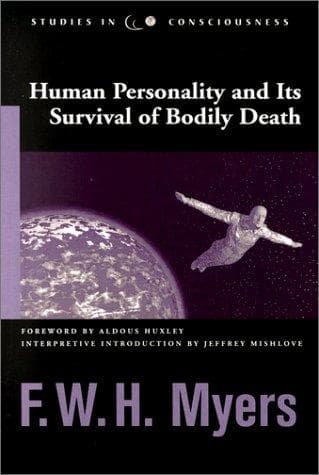
Human Personality and Its Survival of Bodily DeathMyers, F. W. H. (Frederic William Henry)
Religion
Human Personality and Its Survival of Bodily Death
Myers, F. W. H. (Frederic William Henry)
Immortality; Parapsychology; Personality
If once we assume that the deceased person's mind could continue to act
on living persons after his bodily death, then the confused horror of
the series of pictures which were presented to Mrs. Storie's
view--mixed, it should be said, with an element of _fresh departure_
which there was nothing in the accident itself to suggest--would
correspond well enough to what one can imagine a man's feelings a few
hours after such a death to be. This is trespassing, no doubt, on
hazardous ground; but if once we admit communication from the other side
of death as a working hypothesis, we must allow ourselves to imagine
something as to the attitude of the communicating mind, and the least
violent supposition will be that that mind is still in part at least
occupied with the same thoughts which last occupied it on earth. It is
possible that there may be some interpretation of this kind for some of
the cases where a funeral scene, or a dead body, is what the phantasm
presents. There is a remarkable case (i. p. 265) [§ 664] where a lady
sees the body of a well-known London physician--about ten hours after
death--lying in a bare unfurnished room (a cottage hospital abroad).
Here the description, as we have it, would certainly fit best with some
kind of telepathic clairvoyance prolonged after death--some power on the
deceased person's part to cause the percipient to share the picture
which might at that moment be occupying his own mind.
It will be seen that these phenomena are not of so simple a type as to
admit of our considering them from the point of view of _time-relations_
alone. Whatever else, indeed, a "ghost" may be, it is probably one of
the most complex phenomena in nature. It is a function of two unknown
variables--the incarnate spirit's sensitivity and the discarnate
spirit's capacity of self-manifestation. Our attempt, therefore, to
study such intercourse may begin at either end of the
communication--with the percipient or with the agent. We shall have to
ask, How does the incarnate mind receive the message? and we shall have
to ask also, How does the discarnate mind originate and convey it?
Public-domain text, read in full here on John Shaqi.
Reviews
Reviews
No reviews yet
Be the first to share your thoughts on this work.
Elsewhere in the archive
Join the Discussion
Join the discussion
Sign in to leave a comment or review.
Sign InorCreate an account