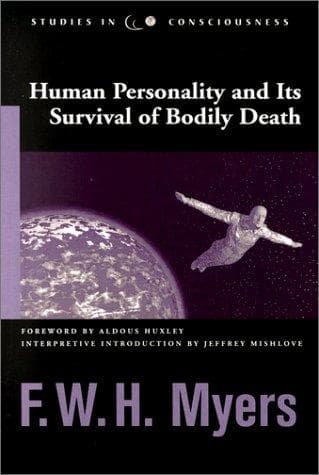
Human Personality and Its Survival of Bodily DeathMyers, F. W. H. (Frederic William Henry)
Religion
Human Personality and Its Survival of Bodily Death
Myers, F. W. H. (Frederic William Henry)
Immortality; Parapsychology; Personality
"Normally at least," says one critic, summarising in a few words the
ordinary view, "all the consciousness we have at any moment corresponds
to all the activity which is going on at that moment in the brain. There
is one unitary conscious state accompanying all the simultaneous brain
excitations together, and each single part of the brain-process
contributes something to its nature. None of the brain-processes split
themselves off from the rest and have a separate consciousness of their
own." This is, no doubt, the apparent dictum of consciousness, but it is
nothing more. And the dicta of consciousness have already been shown to
need correction in so many ways which the ordinary observer could never
have anticipated that we have surely no right to trust consciousness, so
to say, a step further than we can feel it,--to hold that anything
whatever--even a separate consciousness in our own organisms--can be
proved _not_ to exist by the mere fact that we--as we know
ourselves--are not aware of it.
But indeed this claim to a unitary consciousness tends to become less
forcible as it is more scientifically expressed. It rests on the plain
man's conviction that there is only one of him; and this conviction the
experimental psychologist is always tending to weaken or narrow by the
admission of coexistent localised degrees of consciousness in the brain,
which are at any rate not obviously reducible to a single state. Even
those who would stop far short of my own position find it needful to
resort to metaphors of their own to express the different streams of
"awareness" which we all feel to be habitually coexistent within us.
They speak of "fringes" of ordinary consciousness; of "marginal"
associations; of the occasional perception of "currents of low
intensity." These metaphors may all of them be of use, in a region where
metaphor is our only mode of expression; but none of them covers all the
facts now collected. And on the other side, I need not say, are plenty
of phrases which beg the question of soul and body, or of the man's own
spirit and external spirits, in no scientific fashion. There seems to be
need of a term of wider application, which shall make as few assumptions
as possible. Nor is such a term difficult to find.
Public-domain text, read in full here on John Shaqi.
Reviews
Reviews
No reviews yet
Be the first to share your thoughts on this work.
Join the Discussion
Join the discussion
Sign in to leave a comment or review.
Sign InorCreate an account