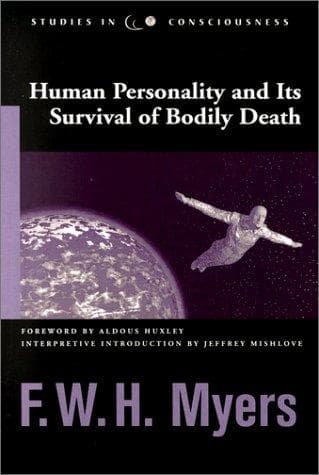
Human Personality and Its Survival of Bodily DeathMyers, F. W. H. (Frederic William Henry)
Religion
Human Personality and Its Survival of Bodily Death
Myers, F. W. H. (Frederic William Henry)
Immortality; Parapsychology; Personality
But in certain cases of violent death there seems to have been an
intention on the deceased person's part to show the condition in which
his body is left. Such was Mrs. Storie's dream, or rather series of
visions referred to earlier in this chapter. Such are the cases given in
_Phantasms of the Living_, vol. i. p. 365 [429 A], and _Proceedings_
S.P.R., vol. iii. (1885) p. 95 [§ 730]. Here, too, may be placed two
cases--those of Dr. Bruce (in Appendix IV. D) and Miss Hall (_Journal_
S.P.R., vol. vii. p. 173 [731 A])--where there are _successive_ pictures
of a death and the subsequent arrangement of the body. The _milieux_ of
the percipients, the nature of the deaths, are here again totally
disparate; yet we seem to see the same unknown laws producing effects
closely similar.
In Dr. Bruce's case one might interpret the visions as coming to the
percipient through the mind of his wife, who was present at the scene of
the murder. But this explanation would be impossible in Miss Hall's
case. Rather it seems as though some telepathic link, set up between the
dying brother and the sister, had been maintained after death until all
duties had been fulfilled to the departed. The case reminds one of the
old Homeric notions of the restless appeal of unburied comrades.
In the case of Mrs. Green (_Proceedings_ S.P.R., vol. v. p. 420 [429
D]), we come across an interesting problem. Two women are drowned under
very peculiar circumstances. A friend has apparently a clairvoyant
vision of the scene, yet not at the moment when it occurred, but many
hours afterwards, and about the time when another person, deeply
interested, heard of the death. It is therefore possible to suppose that
the apparently clairvoyant scene was in reality impressed telepathically
on the percipient by another living mind. I think, however, that both
the nature of the vision and certain analogies, which will appear later
in our argument, point to a different view, involving an agency both of
the dead and of the living. I conjecture that a current of influence may
be started by a deceased person, which, however, only becomes strong
enough to be perceptible to its object when reinforced by some vivid
current of emotion arising in living minds. I do not say that this is
yet provable; yet the hint may be of value when the far-reaching
interdependencies of telepathy between the two worlds come to be better
understood.
Public-domain text, read in full here on John Shaqi.
Reviews
Reviews
No reviews yet
Be the first to share your thoughts on this work.
Elsewhere in the archive
Join the Discussion
Join the discussion
Sign in to leave a comment or review.
Sign InorCreate an account