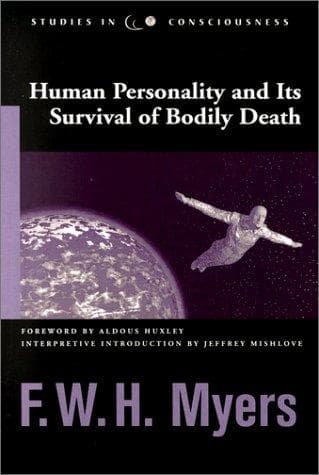
Human Personality and Its Survival of Bodily DeathMyers, F. W. H. (Frederic William Henry)
Religion
Human Personality and Its Survival of Bodily Death
Myers, F. W. H. (Frederic William Henry)
Immortality; Parapsychology; Personality
Two singular cases in this group remain, where the departed spirit, long
after death, seems preoccupied with the spot where his bones are laid.
The first of these cases (_Journal_ S.P.R., vol. vi. p. 230 [733 A])
approaches farce; the second (in which the skeleton of a man who had
probably been murdered about forty years before was discovered by means
of a dream; see _Proceedings_ S.P.R., vol. vi. p. 35), stands alone
among our narratives in the tragedy which follows on the communication.
Mr. Podmore in an article in the same volume (p. 303) suggests other
theories to account for this case without invoking the agency of the
dead; but to me the least impossible explanation is still the notion
that the murdered man's dreams harked back after all those years to his
remote unconsecrated grave. I may refer further to another case (in
_Proceedings_ S.P.R., vol. iv. p. 155, footnote) where feelings of
horror and depression were constantly experienced in a room over which a
baby's body was afterwards found. This case makes, perhaps, for another
explanation--depending not so much on any _continued_ influence of the
departed spirit as on some _persistent_ influence inhering in the bones
themselves--deposited under circumstances of terror or anguish, and
possibly in some way still radiating a malignant memory. Bizarre as this
interpretation looks, we shall find some confirmation of such a
possibility in our chapter on Possession. Yet another case belonging to
the same group (_Proceedings_ S.P.R., vol. v. p. 418) supplies a variant
on this view; suggesting, as Edward Gurney has remarked, the local
imprintation of a tragic picture, by _whom_ and upon _what_ we cannot
tell.
I think it well to suggest even these wild conjectures; so long as they
are understood to be conjectures and nothing more. I hold it probable
that those communications, of which telepathy from one spirit to another
forms the most easily traceable variety, are in reality infinitely
varied and complex, and show themselves from time to time in forms which
must for long remain quite beyond our comprehension.
The next class of cases in this series well illustrates this
unexpectedness. It has only been as the result of a gradual accumulation
of concordant cases that I have come to believe there is some reality in
the bizarre supposition that the departed spirit is sometimes specially
aware of the tune at which news of his death is about to reach some
given friend.[149] Proof of such knowledge on his part is rendered
harder by the alternative possibility that the friend may by
clairvoyance become aware of a letter in his own proximity. As was shown
in _Phantasms of the Living_, there is some evidence for such
clairvoyance even in cases where the letter seen is quite unimportant.
Public-domain text, read in full here on John Shaqi.
Reviews
Reviews
No reviews yet
Be the first to share your thoughts on this work.
Elsewhere in the archive
Join the Discussion
Join the discussion
Sign in to leave a comment or review.
Sign InorCreate an account