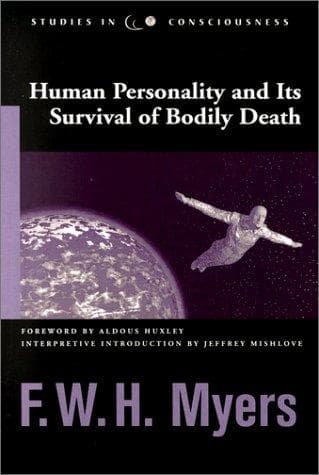
Human Personality and Its Survival of Bodily DeathMyers, F. W. H. (Frederic William Henry)
Religion
Human Personality and Its Survival of Bodily Death
Myers, F. W. H. (Frederic William Henry)
Immortality; Parapsychology; Personality
observers, be held to be something more than a mere subjective fancy;
but what in reality such a picture signifies is a question which brings
us at once to theories of the permanence or simultaneity of all
phenomena in a timeless Universal Soul.
Such conceptions, however difficult, are among the highest to which our
mind can reach. Could we approach them more nearly, they might deeply
influence our view, even of our own remote individual destiny. So,
perhaps, shall it some day be; at present we may be well satisfied if we
can push our knowledge of that destiny one step further than of old,
even just behind that veil which has so long hung impenetrably before
the eyes of men.
Here, then, is a natural place of pause in our inquiry.
The discussion of the ethical aspect of these questions I have postponed
to my concluding chapter. But one point already stands out from the
evidence--at once so important and so manifest that it seems well to
call attention to it at once--as a solvent more potent than any
Lucretius could apply to human superstition and human fears.
In this long string of narratives, complex and bizarre though their
details may be, we yet observe that the character of the appearance
varies in a definite manner with their distinctness and individuality.
Haunting phantoms, incoherent and unintelligent, may seem restless and
unhappy. But as they rise into definiteness, intelligence,
individuality, the phantoms rise also into love and joy. I cannot recall
one single case of a proved posthumous combination of intelligence with
wickedness. Such evil as our evidence will show us--we have as yet
hardly come across it in this book--is scarcely more than monkeyish
mischief, childish folly. In dealing with automatic script, for
instance, we shall have to wonder whence come the occasional vulgar
jokes or silly mystifications. We shall discuss whether they are a kind
of dream of the automatist's own, or whether they indicate the existence
of unembodied intelligences on the level of the dog or the ape. But, on
the other hand, all that world-old conception of Evil Spirits, of
malevolent Powers, which has been the basis of so much of actual
devil-worship and of so much more of vague supernatural fear;--all this
insensibly melts from the mind as we study the evidence before us.
Hunc igitur terrorem animi tenebrasque necessest
Non radii solis, neque lucida tela diei
Discutiant sed, naturæ species ratioque.
Public-domain text, read in full here on John Shaqi.
Reviews
Reviews
No reviews yet
Be the first to share your thoughts on this work.
Elsewhere in the archive
Join the Discussion
Join the discussion
Sign in to leave a comment or review.
Sign InorCreate an account