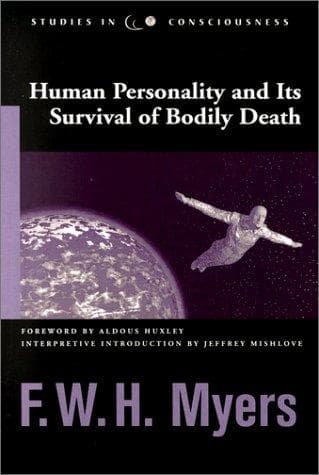
Human Personality and Its Survival of Bodily DeathMyers, F. W. H. (Frederic William Henry)
Religion
Human Personality and Its Survival of Bodily Death
Myers, F. W. H. (Frederic William Henry)
Immortality; Parapsychology; Personality
Here surely is a fact of no little meaning. Our narratives have been
collected from men and women of many types, holding all varieties of
ordinary opinion. Yet the upshot of all these narratives is to emphasise
a point which profoundly differentiates the scientific from the
superstitious view of spiritual phenomena. The terror which shaped
primitive theologies still tinges for the populace every hint of
intercourse with disembodied souls. The transmutation of savage fear
into scientific curiosity is of the essence of civilisation. Towards
that transmutation each separate fragment of our evidence, with
undesigned concordance, indisputably tends. In that faintly opening
world of spirit I can find nothing worse than living men; I seem to
discern not an intensification but a disintegration of selfishness,
malevolence, pride. And is not this a natural result of any cosmic moral
evolution? If the selfish man (as Marcus Antoninus has it) "is a kind of
boil or imposthume upon the universe," must not his egoistic impulses
suffer in that wider world a sure, even if a painful, decay; finding no
support or sustenance among those permanent forces which maintain the
stream of things?
I have thus indicated one point of primary importance on which the
undesignedly coincident testimony of hundreds of first-hand narratives
supports a conclusion, not yet popularly accepted, but in harmony with
the evolutionary conceptions which rule our modern thought. Nor does
this point stand alone. I can find, indeed, no guarantee of absolute and
idle bliss; no triumph in any exclusive salvation. But the student of
these narratives will, I think, discover throughout them uncontradicted
indications of the persistence of Love, the growth of Joy, the willing
submission to Law.
These indications, no doubt, may seem weak and scattered la comparison
with the wholesale, thorough-going assertions of philosophical or
religious creeds. Their advantage is that they occur incidentally in the
course of our independent and cumulative demonstration of the
profoundest cosmical thesis which we can at present conceive as
susceptible of any kind of scientific proof. Cosmical questions, indeed,
there may be which are in themselves of deeper import than our own
survival of bodily death. The nature of the First Cause; the blind or
the providential ordering of the sum of things;--these are problems
vaster than any which affect only the destinies of men. But to whatever
moral certainty we may attain on those mightiest questions, we can
devise no way whatever of bringing them to scientific test. They deal
with infinity; and our modes of investigation have grasp only on finite
things.
Public-domain text, read in full here on John Shaqi.
Reviews
Reviews
No reviews yet
Be the first to share your thoughts on this work.
Elsewhere in the archive
Join the Discussion
Join the discussion
Sign in to leave a comment or review.
Sign InorCreate an account