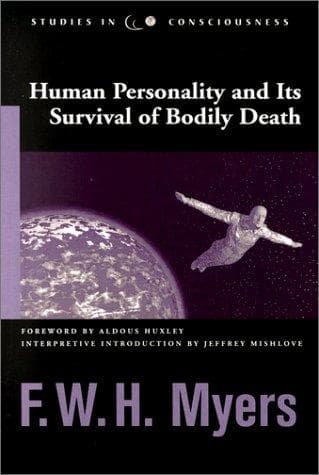
Human Personality and Its Survival of Bodily DeathMyers, F. W. H. (Frederic William Henry)
Religion
Human Personality and Its Survival of Bodily Death
Myers, F. W. H. (Frederic William Henry)
Immortality; Parapsychology; Personality
Motor automatisms, as I define them, are phenomena of very wide range.
We have encountered them already many times in this book. We met them in
the first place in a highly developed form in connection with multiplex
personality in Chapter II. Numerous instances were there given of motor
effects, initiated by secondary selves without the knowledge of the
primary selves, or sometimes in spite of their actual resistance. All
motor action of a secondary self is an automatism in this sense, in
relation to the primary self. And of course we might by analogy extend
the use of the word still further, and might call not only
post-epileptic acts, but also maniacal acts, automatic; since they are
performed without the initiation of the presumedly sane primary
personality. Those degenerative phenomena, indeed, are not to be
discussed in this chapter. Yet it will be well to pause here long enough
to make it clear to the reader just what motor automatisms I am about to
discuss as _evolutive_ phenomena, and as therefore falling within the
scope of this treatise;--and what kind of relation they bear to the
dissolutive motor phenomena which occupy so much larger a place in
popular knowledge.
In order to meet this last question, I must here give more distinct
formulation to a thesis which has already suggested itself more than
once in dealing with special groups of our phenomena.
_It may be expected that supernormal vital phenomena will manifest
themselves as far as possible through the same channels as abnormal or
morbid vital phenomena, when the same centres or the same synergies are
involved._
To illustrate the meaning of this theorem, I may refer to a remark long
ago made by Edmund Gurney and myself in dealing with "Phantasms of the
Living," or veridical hallucinations, generated (as we maintained), not
by a morbid state of the percipient's brain, but by a telepathic impact
from an agent at a distance. We observed that if a hallucination--a
subjective image--is to be excited by this distant energy, it will
probably be most readily excited in somewhat the same manner as the
morbid hallucination which follows on a cerebral injury. We urged that
this is _likely_ to be the case--we showed ground for supposing that it
_is_ the case--both as regards the mode of evolution of the phantasm in
the percipient's brain, and the mode in which it seems to present itself
to his senses.
Public-domain text, read in full here on John Shaqi.
Reviews
Reviews
No reviews yet
Be the first to share your thoughts on this work.
Elsewhere in the archive
Join the Discussion
Join the discussion
Sign in to leave a comment or review.
Sign InorCreate an account