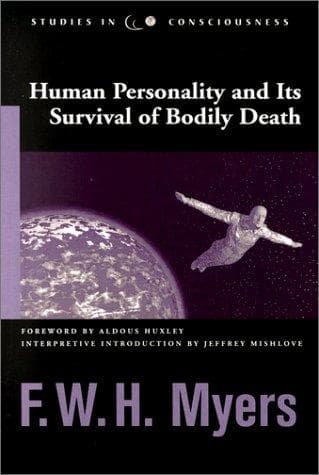
Human Personality and Its Survival of Bodily DeathMyers, F. W. H. (Frederic William Henry)
Religion
Human Personality and Its Survival of Bodily Death
Myers, F. W. H. (Frederic William Henry)
Immortality; Parapsychology; Personality
And here I should wish to give a much wider generality to this
principle, and to argue that if there be within us a secondary self
aiming at manifestation by physiological means, it seems probable that
its readiest _path of externalisation_--its readiest outlet of visible
action--may often lie along some track which has already been shown to
be a line of low resistance by the disintegrating processes of disease.
Or, varying the metaphor, we may anticipate that the partition of the
primary and the secondary self will lie along some plane of cleavage
which the _morbid_ dissociations of our psychical synergies have already
shown themselves disposed to follow. If epilepsy, madness, etc., tend to
_split up_ our faculties in certain ways, automatism is likely to split
them up in ways somewhat resembling these.
But in what way then, it will be asked, do you distinguish the
supernormal from the merely abnormal? Why assume that in these aberrant
states there is anything besides hysteria, besides epilepsy, besides
insanity?
The answer to this question has virtually been given in previous
chapters of this book. The reader is already accustomed to the point of
view which regards all psychical as well as all physiological activities
as necessarily either developmental or degenerative, tending to
evolution or to dissolution. And now, whilst altogether waiving any
teleological speculation, I will ask him hypothetically to suppose that
an evolutionary _nisus_, something which we may represent as an effort
towards self-development, self-adaptation, self-renewal, is discernible
especially on the psychical side of at any rate the higher forms of
life. Our question, Supernormal or abnormal?--may then be phrased,
Evolutive or dissolutive? And in studying each psychical phenomenon in
turn we shall have to inquire whether it indicates a mere degeneration
of powers already acquired, or, on the other hand, the "promise and
potency," if not the actual possession, of powers as yet unrecognised or
unknown.
Thus, for instance, Telepathy is surely a step in _evolution_.[160] To
learn the thoughts of other minds without the mediation of the special
senses, manifestly indicates the possibility of a vast extension of
psychical powers. And any knowledge which we can amass as to the
conditions under which telepathic action takes place will form a
valuable starting-point for an inquiry as to the evolutive or
dissolutive character of unfamiliar psychical states.[161]
Public-domain text, read in full here on John Shaqi.
Reviews
Reviews
No reviews yet
Be the first to share your thoughts on this work.
Elsewhere in the archive
Join the Discussion
Join the discussion
Sign in to leave a comment or review.
Sign InorCreate an account