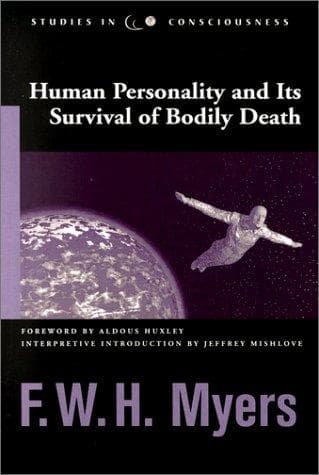
Human Personality and Its Survival of Bodily Death — John Shaqi
Human Personality and Its Survival of Bodily DeathMyers, F. W. H. (Frederic William Henry)
Religion
Human Personality and Its Survival of Bodily Death
Myers, F. W. H. (Frederic William Henry)
Immortality; Parapsychology; Personality
These far-reaching speculations make the element of keenest interest in
the inquiry which follows. But even apart from its possible bearing on a
future life, the further study of our submerged mentation,--of the
processes within us of which we catch only indirect, and as it were,
refracted glimpses,--seems at this time especially called for by the
trend of modern research. For of late years we have realised more and
more fully upon how shifting and complex a foundation of ancestral
experience each individual life is based. In recapitulation, in summary,
in symbol, we retraverse, from the embryo to the corpse, the history of
life on earth for millions of years. During our self-adaptation to
continually wider environments, there may probably have been a continual
displacement of the threshold of consciousness;--involving the lapse and
submergence of much that once floated in the main stream of our being.
Our consciousness at any given stage of our evolution is but the
phosphorescent ripple on an unsounded sea. And, like the ripple, it is
not only superficial but manifold. Our psychical unity is federative and
unstable; it has arisen from irregular accretions in the remote past; it
consists even now only in the limited collaboration of multiple groups.
These discontinuities and incoherences in the Ego the elder
psychologists managed to ignore. Yet infancy, idiocy, sleep, insanity,
decay;--these breaks and stagnancies in the conscious stream were always
present to show us, even more forcibly than more delicate analyses show
us now, that the first obvious conception of man's continuous and
unitary personality was wholly insecure; and that if indeed a soul
inspired the body, that soul must be sought for far beneath these bodily
conditions by which its self-manifestation was clouded and obscured.
The difference between older and newer conceptions of the unifying
principle or soul (if soul there be) in man, considered as manifesting
through corporeal limitations, will thus resemble the difference between
the older and newer conceptions of the way in which the sun reveals
himself to our senses. Night and storm-cloud and eclipse men have known
from the earliest ages; but now they know that even at noonday the
sunbeam which reaches them, when fanned out into a spectrum, is barred
with belts and lines of varying darkness;--while they have learnt also
that where at either end the spectrum fades out into what for us is
blackness, there stretches onwards in reality an undiscovered
illimitable ray.
Public-domain text, read in full here on John Shaqi.
Reviews
Reviews
No reviews yet
Be the first to share your thoughts on this work.
Join the Discussion
Join the discussion
Sign in to leave a comment or review.
Sign InorCreate an account