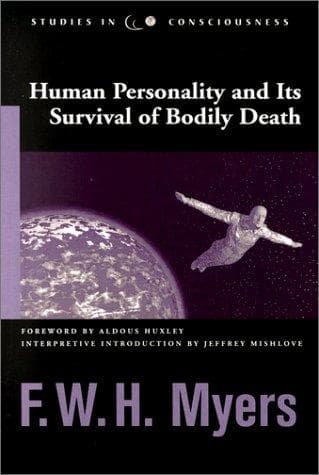
Human Personality and Its Survival of Bodily DeathMyers, F. W. H. (Frederic William Henry)
Religion
Human Personality and Its Survival of Bodily Death
Myers, F. W. H. (Frederic William Henry)
Immortality; Parapsychology; Personality
It was plain that these writings could not be judged aright without a
wide analysis of similar scripts,--without an experimental inquiry into
what the human mind, in states of somnambulism or the like, could
furnish of written messages, apart from the main stream of
consciousness. By his experiments on writing obtained in different
stages of hypnotic trance, Gurney acted as the pioneer of a long series
of researches which, independently set on foot by Professor Pierre Janet
in France, have become of high psychological, and even medical,
importance. What is here of prime interest is the indubitable fact that
fresh personalities can be artificially and temporarily created, which
will write down matter quite alien from the first personality's
character, and even matter which the first personality never knew. That
matter may consist merely of reminiscences of previous periods when the
second personality has been in control. But, nevertheless, if these
writings are shown to the primary personality, he will absolutely
repudiate their authorship--alleging not only that he has no
recollection of writing them, but also that they contain allusions to
facts which he never knew. Some of these messages, indeed, although
their source is so perfectly well defined--although we know the very
moment when the secondary personality which wrote them was called into
existence--do certainly look more alien from the automatist in his
normal state than many of the messages which claim to come from spirits
of lofty type. It is noticeable, moreover, that these manufactured
personalities sometimes cling obstinately to their fictitious names, and
refuse to admit that they are in reality only aspects or portions of the
automatist himself. This must be remembered when the persistent _claim_
to some spiritual identity--say Napoleon--is urged as an argument for
attributing a series of messages to that special person.
What has now been said may suffice as regards the varieties of
mechanism--the different forms of motor automatism--which the messages
employ. I shall pass on to consider the _contents_ of the messages, and
shall endeavour to classify them according to their apparent sources.
_A._ In the first place, the message may come from the percipient's own
mind; its contents being supplied from the resources of his ordinary
memory, or of his more extensive subliminal memory; while the
_dramatisation_ of the message--its assumption of some other mind as its
source--will resemble the dramatisations of dream or of hypnotic trance.
Of course the absence of facts unknown to the writer is not in itself a
proof that the message does not come from some other mind. We cannot be
sure that other minds, if they can communicate, will always be at the
pains to fill their messages with evidential facts. But, equally of
course, a message devoid of such facts must not, on the strength of its
mere assertions, be claimed as the product of any but the writer's own
mind.
Public-domain text, read in full here on John Shaqi.
Reviews
Reviews
No reviews yet
Be the first to share your thoughts on this work.
Elsewhere in the archive
Join the Discussion
Join the discussion
Sign in to leave a comment or review.
Sign InorCreate an account