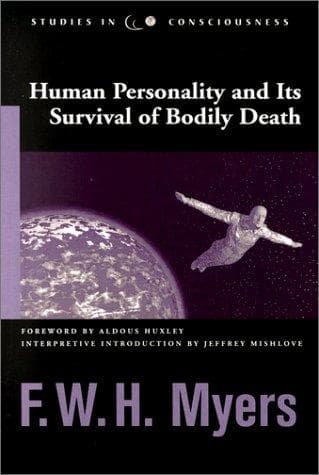
Human Personality and Its Survival of Bodily Death — John Shaqi
Human Personality and Its Survival of Bodily DeathMyers, F. W. H. (Frederic William Henry)
Religion
Human Personality and Its Survival of Bodily Death
Myers, F. W. H. (Frederic William Henry)
Immortality; Parapsychology; Personality
The book which is now at last given to the world is but a partial
presentation of an ever-growing subject which I have long hoped to
become able to treat in more adequate fashion. But as knowledge
increases life rolls by, and I have thought it well to bring out while I
can even this most imperfect text-book to a branch of research whose
novelty and strangeness call urgently for some provisional
systematisation, which, by suggesting fresh inquiries and producing
further accumulation of evidence, may tend as speedily as possible to
its own supersession. Few critics of this book can, I think, be more
fully conscious than its author of its defects and its lacunæ; but also
few critics, I think, have yet realised the importance of the new facts
which in some fashion the book does actually present.
Many of these facts have already appeared in _Phantasms of the Living_;
many more in the _Proceedings_ of the Society for Psychical Research;
but they are far indeed from having yet entered into the scientific
consciousness of the age. In future years the wonder, I think, will be
that their announcement was so largely left to a writer with leisure so
scanty, and with scientific equipment so incomplete.
Whatever value this book may possess is in great measure due to other
minds than its actual author's. Its very existence, in the first place,
probably depends upon the existence of the two beloved friends and
invaluable coadjutors to whose memory I dedicate it now.
The help derived from these departed colleagues, Henry Sidgwick and
Edmund Gurney, although of a kind and quantity absolutely essential to
the existence of this work, is not easy to define in all its fulness
under the changed circumstances of to-day. There was indeed much which
is measurable;--much of revision of previous work of my own, of
collaborative experiments, of original thought and discovery. Large
quotations purposely introduced from Edmund Gurney indicate, although
imperfectly, how closely interwoven our work on all these subjects
continued to be until his death. But the benefit which I drew from the
association went deeper still. The conditions under which this inquiry
was undertaken were such as to emphasise the need of some intimate moral
support. A recluse, perhaps, or an eccentric,--or a man living mainly
with his intellectual inferiors, may find it easy to work steadily and
confidently at a task which he knows that the bulk of educated men will
ignore or despise. But this is more difficult for a man who feels
manifold links with his kind, a man whose desire it is to live among
minds equal or superior to his own. It is hard, I say, for such a man to
disregard altogether the expressed or implied disapproval of those
groups of weighty personages to whom in other matters he is accustomed
to look up.
Public-domain text, read in full here on John Shaqi.
Reviews
Reviews
No reviews yet
Be the first to share your thoughts on this work.
Join the Discussion
Join the discussion
Sign in to leave a comment or review.
Sign InorCreate an account