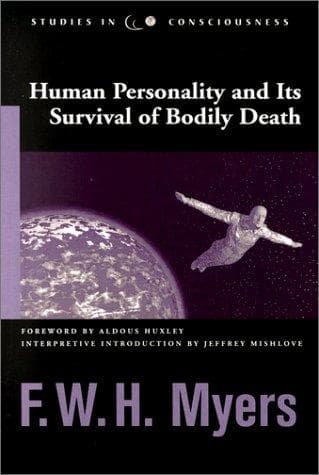
Human Personality and Its Survival of Bodily DeathMyers, F. W. H. (Frederic William Henry)
Religion
Human Personality and Its Survival of Bodily Death
Myers, F. W. H. (Frederic William Henry)
Immortality; Parapsychology; Personality
And when M. Stramm, three days after the death, wrote to his
daughter in Russia to tell her of it, he also used the same
expression, "un engorgement de sang," thus disguising the actual
truth in order to spare the feelings of his daughter, who had
formerly refused to marry Duvanel, and who (as her father feared)
might receive a painful shock if she learnt the tragic nature of
his end. There was, therefore, a singular coincidence between the
automatic and the normally-written message as to the death;--a
coincidence which looks as though the same mind had been at work
in each instance. But that mind cannot have been M. Stramm's
ordinary mind, as he was not supraliminally aware of Duvanel's
death at the time when the first message was written. It may,
however, be supposed that his subliminal self had received the
information of the death telepathically, had transmitted it in a
deliberately modified form to his daughter, while it remained
latent in himself, and had afterwards influenced his supraliminal
self to modify the information in the same way when writing to her.
(2) But we must also consider the explanation of the coincidence
given by the intelligence which controlled the automatic writing.
That intelligence asserted itself to be a brother of Mdlle.
Stramm's, who died some years before. And this "Louis" further
asserted that he had himself influenced M. Stramm to make use of
the same euphemistic phrase, with the object of avoiding a shock to
Mdlle. Stramm; for which purpose it was needful that the two
messages should agree in ascribing the death to the same form of
sudden illness.
Now if this be true, and the message did indeed come from the
deceased "Louis," we have an indication of continued existence, and
continued knowledge of earthly affairs, on the part of a person
long dead.
But if we consider that the case, as presented to us, contains no
proof of "Louis'" identity, so that "Louis" may be merely one of
those arbitrary names which the automatist's subliminal
intelligence seems so prone to assume; then we must suppose that
Duvanel was actually operative on two occasions after death, first
inspiring in Mdlle. Stramm the automatic message, and then
modifying in M. Stramm the message which the father might otherwise
have sent.
I next quote a case in Appendix VIII. D which illustrates the continued
terrene knowledge on the part of the dead of which other instances were
given in the last chapter.
Public-domain text, read in full here on John Shaqi.
Reviews
Reviews
No reviews yet
Be the first to share your thoughts on this work.
Elsewhere in the archive
Join the Discussion
Join the discussion
Sign in to leave a comment or review.
Sign InorCreate an account