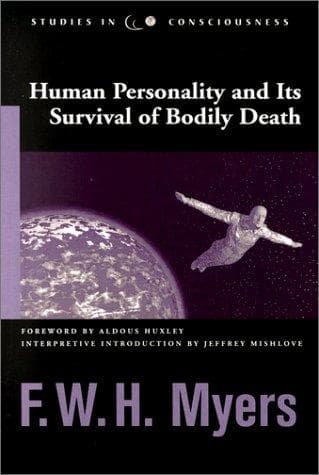
Human Personality and Its Survival of Bodily DeathMyers, F. W. H. (Frederic William Henry)
Religion
Human Personality and Its Survival of Bodily Death
Myers, F. W. H. (Frederic William Henry)
Immortality; Parapsychology; Personality
And lastly, I give in Appendix VIII. E a case which in one respect
stands alone. It narrates the success of a direct experiment,--a
test-message planned before death, and communicated after death, by a
man who held that the hope of an assurance of continued existence was
worth at least a resolute effort, whatever its result might be. His
tests, indeed, were two, and both were successful. One was the revealing
of the place where, before death, he hid a piece of brick marked and
broken for special recognition, and the other was the communication of
the contents of a short letter which he wrote and sealed before death.
We may say that the information was certainly not possessed
supraliminally by any living person. There are two other cases
(_Proceedings_ S.P.R., vol. vi. pp. 353-355, and _op. cit._ vol viii.
pp. 238-242 [876 A and B]) where information given through automatists
may hypothetically be explicable by telepathy from the living, although,
indeed, in my own view, it probably emanated from the deceased as
alleged. In one of these cases the place where a missing will had been
hidden was revealed to the automatist, but it is not clear whether the
will was actually discovered or not before the automatic writing was
obtained (although the automatist was unaware of its discovery), and in
any case, apparently, its whereabouts was known to some living person
who had hidden it, and may not have been known to the deceased before
death.
In the other case the whereabouts of a missing note of hand was revealed
to the automatists, and even if this could be regarded as absolutely
unknown supraliminally to any living person, it is not by any means
certain that the fact was known before death to the deceased person from
whom the message purported to come.
These cases, therefore, are not such strong evidence for personal
identity as the one to which I have referred above, and which I have
given, as recording what purports to be the successful accomplishment of
an experiment which every one may make;--which every one _ought_ to
make;--for, small as may be the chances of success, a few score of
distinct successes would establish a presumption of man's survival which
the common sense of mankind would refuse to explain away.
Public-domain text, read in full here on John Shaqi.
Reviews
Reviews
No reviews yet
Be the first to share your thoughts on this work.
Elsewhere in the archive
Join the Discussion
Join the discussion
Sign in to leave a comment or review.
Sign InorCreate an account