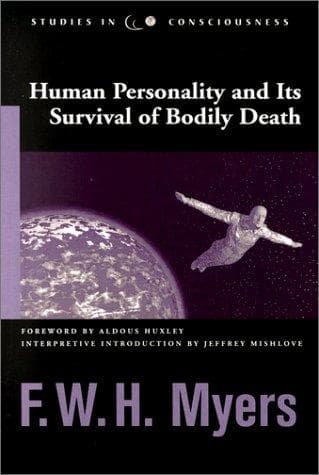
Human Personality and Its Survival of Bodily DeathMyers, F. W. H. (Frederic William Henry)
Religion
Human Personality and Its Survival of Bodily Death
Myers, F. W. H. (Frederic William Henry)
Immortality; Parapsychology; Personality
But as we go further we can no longer limit the problem in this way,--to
the activities of the automatist's subliminal self. We cannot always
assume that some portion of the automatist's personality gets at the
supernormal knowledge by some effort of its own. Our evidence, as we
know, has pointed decisively to telepathic impacts or influences from
without. What, then, is the mechanism here? Are we still to suppose that
the automatist's subliminal self executes the movements--obeying somehow
the bidding of the impulse from without? or does the external agent, who
sends the telepathic message, himself execute the movements also,
directly using the automatist's arm? And if telekinetic movements
accompany the message (a subject thus far deferred, but of prime
importance), are we to suppose that these also are effected by the
percipient's subliminal self, under the guidance of some external
spirit, incarnate or discarnate? or are they effected directly by that
external spirit?
We cannot really say which of these two is the easier hypothesis.
From one point of view it may seem simpler to keep as long as we can to
that acknowledged _vera causa_, the automatist's subliminal self; and to
collect such observations as may indicate any power on its part of
producing physical effects outside the organism. Such scattered
observations occur at every stage, and even Mrs. Newnham (I may briefly
observe in passing) thought that her pencil, when writing down the
messages telepathically derived from her husband, was moved by something
other than the ordinary muscular action of the fingers which held it. On
the other hand, there seems something very forced in attributing to an
external spirit's agency impulses and impressions which seem intimately
the automatist's own, and at the same time refusing to ascribe to that
external agency phenomena which take place outside the automatist's
organism, and which present themselves to him as objective facts, as
much outside his own being as the fall of the apple to the ground.
Reflecting on such points--and once admitting this kind of interaction
between the automatist's own spirit and an external spirit, incarnate or
discarnate--we find the possible combinations presenting themselves in
perplexing variety;--a variety both of agencies on the part of the
invading spirit, and of effects on the part of the invaded spirit and
organism.
What is that which invades? and what is that which is displaced or
superseded by this invasion? In what ways may two spirits co-operate in
the possession and control of the same organism?
Public-domain text, read in full here on John Shaqi.
Reviews
Reviews
No reviews yet
Be the first to share your thoughts on this work.
Elsewhere in the archive
Join the Discussion
Join the discussion
Sign in to leave a comment or review.
Sign InorCreate an account