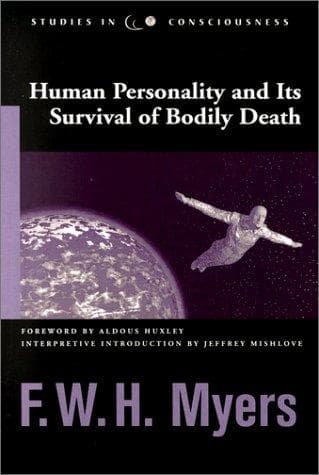
Human Personality and Its Survival of Bodily DeathMyers, F. W. H. (Frederic William Henry)
Religion
Human Personality and Its Survival of Bodily Death
Myers, F. W. H. (Frederic William Henry)
Immortality; Parapsychology; Personality
Phrased in this manner, the telepathic impact seemed the less startling,
the less extreme hypothesis of the two,--mainly, perhaps, because the
picture which it called up was left so vague and obscure. But now
instead of a fleeting hallucination we have to deal with a strong and
lasting impulse--such, for instance, as the girl's impulse to _write_,
in Dr. Liébeault's case (Appendix VIII. C):--an impulse which seems to
come from the depths of the being, and which (like a post-hypnotic
suggestion) may override even strong disinclination, and keep the
automatist uncomfortable until it has worked itself out. We may still
call this a _telepathic impact_, if we will, but we shall find it hard
to distinguish that term from a _psychical invasion_. This strong, yet
apparently alien, motor innervation corresponds in fact as closely as
possible to our idea of an _invasion_--an invasion no longer of the room
only in which the percipient is sitting, but of his own body and his own
powers. It is an invasion which, if sufficiently prolonged, would become
a _possession_; and it both unites and intensifies those two earlier
conjectures;--of telepathic impact on the percipient's mind, and of
"phantasmogenetic presence" in the percipient's surroundings. What
seemed at first a mere impact is tending to become a persistent control;
what seemed an incursion merely into the percipient's environment has
become an incursion into his organism itself.
As has been usual in this inquiry, this slight forward step from
vagueness to comparative clearness of conception introduces us at once
to a whole series of novel problems. Yet, as we have also learnt to
expect, some of our earlier phenomena may have to be called in with
advantage to illustrate phenomena more advanced.
In cases of split personality, to begin with, we have seen just the same
phenomena occurring where certainly no personality was concerned save
the percipient's own. We have seen a section of the subliminal self
partially or temporarily dominating the organism; perhaps controlling
permanently one arm alone;[193] or perhaps controlling intermittently
the whole nervous system;--and all this with varying degrees of
displacement of the primary personality.
Similarly with post-hypnotic suggestion. We have seen the subliminal
self ordered to write (say) "It has left off raining"--and thereupon
writing the words without the conscious will of the automatist--and
again with varying degrees of displacement of the waking self. The step
hence to such a case as Mrs. Newnham's is thus not a very long one. Mrs.
Newnham's subliminal self, exercising supernormal faculty, and by some
effort of its own, acquires certain facts from Mr. Newnham's mind, and
uses her hand to write them down automatically. The great problem here
introduced is how the subliminal self acquires the facts, rather than
how it succeeds in writing them down when it has once acquired them.
Public-domain text, read in full here on John Shaqi.
Reviews
Reviews
No reviews yet
Be the first to share your thoughts on this work.
Elsewhere in the archive
Join the Discussion
Join the discussion
Sign in to leave a comment or review.
Sign InorCreate an account