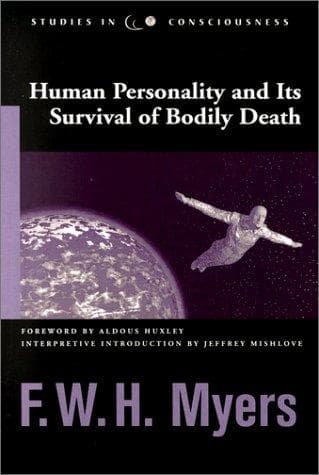
Human Personality and Its Survival of Bodily DeathMyers, F. W. H. (Frederic William Henry)
Religion
Human Personality and Its Survival of Bodily Death
Myers, F. W. H. (Frederic William Henry)
Immortality; Parapsychology; Personality
His manifestations may differ very considerably from the automatist's
normal personality. Yet in one sense it is a process of selection rather
than of addition; the spirit selects what parts of the brain-machinery
he will use, but he cannot get out of that machinery more than it is
constructed to perform. The spirit can indeed produce facts and names
unknown to the automatist; but they must be, as a rule, such facts and
names as the automatist could easily have repeated, had they been known
to him:--not, for instance, mathematical formulæ or Chinese sentences,
if the automatist is ignorant of mathematics or of Chinese.
After a time the control gives way, and the automatist's spirit returns.
The automatist, awaking, may or may not remember his experiences in the
spiritual world during the trance. In some cases (Swedenborg) there is
this memory of the spiritual world, but no possession of the organism by
an external spirit. In others (Cahagnet's subject) there is utterance
during the trance as to what is being discerned by the automatist, yet
no memory thereof on waking. In others (Mrs. Piper) there is neither
utterance as a rule, or at least no prolonged utterance, by the
automatist's own spirit, nor subsequent memory; but there is writing or
utterance during the trance by controlling spirits.
Now this seems a strange doctrine to have reached after so much
disputation. For it simply brings us back to the creeds of the Stone
Age. We have come round again to the primitive practices of the shaman
and the medicine-man;--to a doctrine of spiritual intercourse which was
once œcumenical, but has now taken refuge in African swamps and
Siberian tundras and the snow-clad wastes of the Red Indian and the
Esquimaux. If, as is sometimes advised, we judge of the worth of ideas
by tracing their _origins_, no conception could start from a lower level
of humanity. It might be put out of court at once as unworthy of
civilised men.
Fortunately, however, our previous discussions have supplied us with a
somewhat more searching criterion. Instead of asking in what age a
doctrine originated--with the implied assumption that the more recent it
is, the better--we can now ask how far it is in accord or in discord
with a great mass of actual recent evidence which comes into contact, in
one way or another, with nearly every belief as to an unseen world which
has been held at least by western men. Submitted to this test, the
theory of possession gives a remarkable result. It cannot be said to be
inconsistent with any of our proved facts. We know absolutely nothing
which negatives its possibility.
Public-domain text, read in full here on John Shaqi.
Reviews
Reviews
No reviews yet
Be the first to share your thoughts on this work.
Elsewhere in the archive
Join the Discussion
Join the discussion
Sign in to leave a comment or review.
Sign InorCreate an account