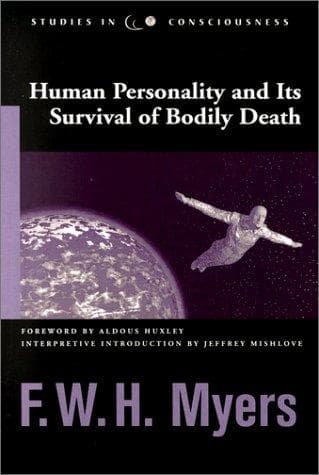
Human Personality and Its Survival of Bodily DeathMyers, F. W. H. (Frederic William Henry)
Religion
Human Personality and Its Survival of Bodily Death
Myers, F. W. H. (Frederic William Henry)
Immortality; Parapsychology; Personality
Nay, more than this. The theory of possession actually supplies us with
a powerful method of co-ordinating and explaining many earlier groups of
phenomena, if only we will consent to explain them in a way which at
first sight seemed extreme in its assumptions--seemed unduly prodigal of
the marvellous. Yet as to that difficulty we have learnt by this time
that no explanation of psychical phenomena is really simple, and that
our best clue is to get hold of some group which seems to admit of one
interpretation only, and then to use that group as a _point de repère_
from which to attack more complex problems.
Now I think that the Moses-Piper group of trance-phenomena cannot be
intelligently explained on any theory except that of possession. And I
therefore think it important to consider in what way earlier phenomena
have led up to possession, and in what way the facts of possession, in
their turn, affect our view of these earlier phenomena.
If we analyse our observations of possession, we find two main
factors--the central operation, which is the control by a spirit of the
sensitive's organism; and the indispensable prerequisite, which is the
partial and temporary desertion of that organism by the percipient's own
spirit.
Let us consider first how far this withdrawal of the living man's spirit
from his organism has been rendered conceivable by evidence already
obtained.
First of all, the splits, and substitutions of phases of personality
with which our second chapter made us familiar have great significance
for _possession_ also.
We have there seen some secondary personality, beginning with slight and
isolated sensory and motor manifestations, yet going on gradually to
complete predominance,--complete control of all supraliminal
manifestation.
The mere collection and description of such phenomena has up till now
savoured of a certain boldness. The idea of tracing the possible
mechanism involved in these transitions has scarcely arisen.
Yet it is manifest that there must be a complex set of laws concerned
with such alternating use of brain-centres;--developments, one may
suppose, of those unknown physical laws underlying ordinary memory, of
which no one has formed as yet even a first rough conception.
Public-domain text, read in full here on John Shaqi.
Reviews
Reviews
No reviews yet
Be the first to share your thoughts on this work.
Elsewhere in the archive
Join the Discussion
Join the discussion
Sign in to leave a comment or review.
Sign InorCreate an account