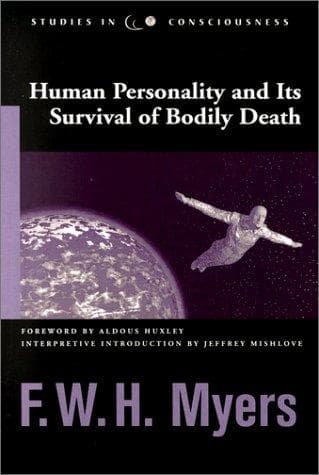
Human Personality and Its Survival of Bodily DeathMyers, F. W. H. (Frederic William Henry)
Religion
Human Personality and Its Survival of Bodily Death
Myers, F. W. H. (Frederic William Henry)
Immortality; Parapsychology; Personality
An ordinary case of ecmnesia may present problems as insoluble in their
way as those offered by spirit-possession itself. There may be in
ecmnesia periods of life absolutely and permanently extruded from
memory; and there may be also periods which are only temporarily thus
extruded. Thus on Wednesday and Thursday I may be unaware of what I
learnt and did on Monday and Tuesday; and then on Friday I may recover
Monday's and Tuesday's knowledge, as well as retaining Wednesday's and
Thursday's, so that my brain-cells have taken on, so to say, two
separate lines of education since Sunday--that which began on Monday,
and that which began on Wednesday. These intercurrent educations may
have been naturally discordant, and may be fused in all kinds of ways in
the ultimate synthesis.
These processes are completely obscure; and all that can be said is that
their mechanism probably belongs to the same unknown series of
operations which ultimately lead to that completest break in the history
of the brain-cells which consists in their intercalary occupation by an
external spirit.
Passing on to _genius_, which I discussed in my third chapter, it is
noticeable that there also there is a certain degree of temporary
substitution of one control for another over important brain-centres. We
must here regard the subliminal self as an entity partially distinct
from the supraliminal, and its occupation of these brain-centres
habitually devoted to supraliminal work is a kind of possession, which
illustrates in yet another way the rapid metastasis of psychical product
(so to term it) of which these highest centres are capable. The highest
genius would thus be the completest _self-possession_,--the occupation
and dominance of the whole organism by those profoundest elements of the
self which act from the fullest knowledge, and in the wisest way.
The next main subject which fell under our description was _sleep_. And
this state--the normal state which most resembles trance--has long ago
suggested the question which first hints at the possibility of ecstasy,
namely, What becomes of the soul during sleep? I think that our evidence
has shown that sometimes during apparent ordinary sleep the spirit may
travel away from the body, and may bring back a memory, more or less
confused, of what it has seen in this clairvoyant excursion. This may
indeed happen for brief flashes during waking moments also. But ordinary
sleep seems to help the process; and deeper states of sleep--spontaneous
or induced--seem still further to facilitate it. In the coma preceding
death, or during that "suspended animation" which is sometimes taken for
death, this travelling faculty has seemed to reach its highest point.
Public-domain text, read in full here on John Shaqi.
Reviews
Reviews
No reviews yet
Be the first to share your thoughts on this work.
Elsewhere in the archive
Join the Discussion
Join the discussion
Sign in to leave a comment or review.
Sign InorCreate an account