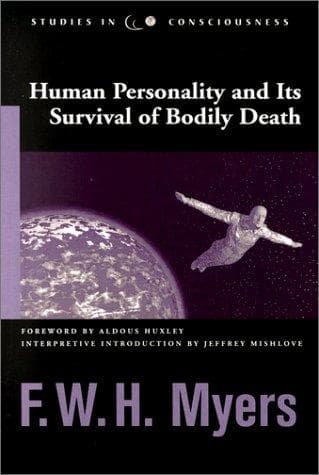
Human Personality and Its Survival of Bodily Death — John Shaqi
Human Personality and Its Survival of Bodily DeathMyers, F. W. H. (Frederic William Henry)
Religion
Human Personality and Its Survival of Bodily Death
Myers, F. W. H. (Frederic William Henry)
Immortality; Parapsychology; Personality
Let us dwell for a few moments on the nature of these fixed or insistent
ideas. They are not generally or at the first outset extravagant
fancies,--as that one is made of glass or the like. Rather will "fixed
ideas" come to seem a mere expression for something in a minor degree
common to most of us. Hardly any mind, I suppose, is wholly free from
tendencies to certain types of thought or emotion for which we cannot
summon any adequate check--useless recurrent broodings over the past or
anxieties for the future, perhaps traces of old childish experience
which have become too firmly fixed wholly to disappear. Nay, it may well
be that we must look even further back than our own childhood for the
origin of many haunting troubles. Inherited tendencies to terror,
especially, seem to reach far back into a prehistoric past. In a recent
"Study of Fears," which Professor Stanley Hall has based on a wide
statistical collection,[8] it would seem that the fears of childhood
often correspond to no existing cause for uneasiness, but rather to the
vanished perils of primitive man. The fear of darkness, for instance,
the fear of solitude, the fear of thunder-storms, the fear of the loss
of orientation, speak of primitive helplessness, just as the fear of
animals, the fear of strangers, suggest the fierce and hazardous life of
early man. To all such instinctive feelings as these a morbid
development is easily given.
Of what nature must we suppose this morbid development to be? Does it
fall properly within our present discussion? or is it not simply a
beginning of brain-disease, which concerns the physician rather than the
psychologist? The psychologist's best answer to this question will be to
show cases of fixed ideas _cured_ by psychological means.[9] And indeed
there are few cases to show which have been cured by any methods
_except_ the psychological; if hypnotic suggestion does not succeed with
an _idée fixe_, it is seldom that any other treatment will cure it. We
may, of course, say that the brain troubles thus cured were functional,
and that those which went on inevitably into insanity were organic,
although the distinction between functional and organic is not easily
demonstrable in this ultra-microscopic realm.
At any rate, we have actually on record,--and that is what our argument
needs,--a great series of _idées fixes_, of various degrees of
intensity, cured by suggestion;--cured, that is to say, by a subliminal
setting in action of minute nervous movements which our supraliminal
consciousness cannot in even the blindest manner manage to set to work.
Some such difference as exists on a gross scale between striped and
unstriped muscle seems to exist on a minute scale among these smallest
involved cells and fibres, or whatever they be. Some of them obey our
conscious will, but most of them are capable of being governed only by
subliminal strata of the self.
Public-domain text, read in full here on John Shaqi.
Reviews
Reviews
No reviews yet
Be the first to share your thoughts on this work.
Join the Discussion
Join the discussion
Sign in to leave a comment or review.
Sign InorCreate an account