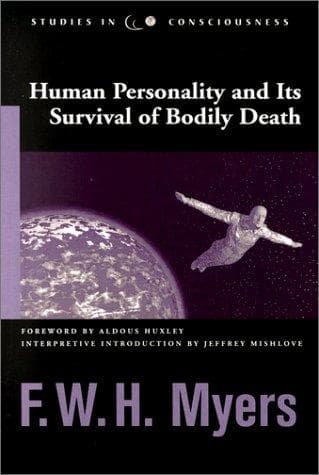
Human Personality and Its Survival of Bodily DeathMyers, F. W. H. (Frederic William Henry)
Religion
Human Personality and Its Survival of Bodily Death
Myers, F. W. H. (Frederic William Henry)
Immortality; Parapsychology; Personality
In minor matters I have aimed above all things at clearness and
readiness in reference. The division of the book into sections, with
Appendices bearing the same numbers, will, it is hoped, facilitate the
use both of syllabus and of references in general. I have even risked
the appearance of pedantry in adding a glossary. Where many unfamiliar
facts and ideas have to be dealt with, time is saved in the end if the
writer explains precisely what his terms mean.
* * * * *
F. W. H. MYERS.
GLOSSARY
NOTE.--The words and phrases here included fall under three main
heads:--
(1) Words common only in philosophical or medical use.
(2) Words or phrases used in psychical research with some special
significance.
(3) A few words, distinguished by an asterisk, for which the author
is himself responsible.
_Aboulia._--Loss of power of willing.
_After-image._--A retinal picture of an object seen after removing the
gaze from the object.
_Agent._--The person who seems to initiate a telepathic transmission.
_Agraphia._--Lack of power to write words.
_Alexia_ or _Word-blindness_.--Lack of power to understand words
written.
_Anæsthesia_, or the loss of sensation generally, must be distinguished
from _analgesia_, or the loss of the sense of pain alone.
_Analgesia._--Insensibility to pain.
_Aphasia._--Incapacity of coherent utterance, not caused by structural
impairment of the vocal organs, but by lesion of the cerebral centres
for speech.
_Aphonia._--Incapacity of uttering sounds.
_Automatic._--Used of mental images arising and movements made without
the initiation, and generally without the concurrence, of conscious
thought and will. _Sensory automatism_ will thus include visual and
auditory hallucinations. _Motor automatism_ will include messages
written and words uttered without intention (automatic script,
trance-utterance, etc.).
_Automnesia._--Spontaneous revival of memories of an earlier condition
of life.
_Autoscope._--Any instrument which reveals a subliminal motor impulse or
sensory impression, _e.g._, a divining rod, a tilting table, or a
planchette.
_Bilocation._--The sensation of being in two different places at once,
namely where one's organism is, and in a place distant from it.
_Catalepsy._--"An intermittent neurosis producing inability to change
the position of a limb, while another person can place the muscles in a
state of flexion or contraction as he will." (Tuke's _Dictionary of
Psychological Medicine_.)
_Centre of Consciousness._--The place where a percipient imagines
himself to be. The point of view from which he seems to himself to be
surveying some phantasmal scene.
_Chromatism._--See _Secondary Sensations_.
_Clair-audience._--The sensation of hearing an internal (but in some way
veridical) voice.
_Clairvoyance_ (_Lucidité_).--The faculty or act of perceiving, as
though visually, with some coincidental truth, some distant scene.
Public-domain text, read in full here on John Shaqi.
Reviews
Reviews
No reviews yet
Be the first to share your thoughts on this work.
Join the Discussion
Join the discussion
Sign in to leave a comment or review.
Sign InorCreate an account