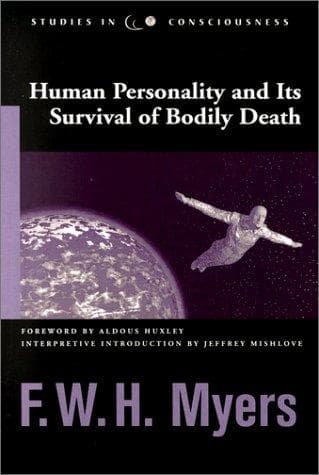
Human Personality and Its Survival of Bodily DeathMyers, F. W. H. (Frederic William Henry)
Religion
Human Personality and Its Survival of Bodily Death
Myers, F. W. H. (Frederic William Henry)
Immortality; Parapsychology; Personality
Now among these thirteen names we have two men of transcendent, and
three of high ability. What accounts have they given us of their
methods?
Of the gift of Gauss and Ampère we know nothing except a few striking
anecdotes. After manifesting itself at an age when there is usually no
continuous supraliminal mental effort worth speaking of, it appears to
have been soon merged in the general blaze of their genius. With Bidder
the gift persisted through life, but grew weaker as he grew older. His
paper in Vol. XV. of the _Proceedings of the Institute of Civil
Engineers_, while furnishing a number of practical hints to the
calculator, indicates also a singular readiness of communication between
different mental strata. "Whenever," he says (p. 255) "I feel called
upon to make use of the stores of my mind, they seem to rise with the
rapidity of lightning." And in Vol. CIII. of the same _Proceedings_, Mr.
W. Pole, F.R.S., in describing how Mr. Bidder could determine mentally
the logarithm of any number to 7 or 8 places, says (p. 252): "He had an
almost miraculous power of seeing, as it were, intuitively what factors
would divide any large number, not a prime. Thus, if he were given the
number 17,861, he would instantly remark it was 337×53.... He could not,
he said, explain how he did this; it seemed a natural instinct to him."
Passing on to the two other men of high ability known to have possessed
this gift, Professor Safford and Archbishop Whately, we are struck with
the evanescence of the power after early youth,--or even before the end
of childhood. I quote from Dr. Scripture Archbishop Whately's account of
his powers.
There was certainly something peculiar in my calculating faculty.
It began to show itself at between five and six, and lasted about
three years.... I soon got to do the most difficult sums, always in
my head, for I knew nothing of figures beyond numeration. I did
these sums much quicker than any one could upon paper, and I never
remember committing the smallest error. _When I went to school, at
which time the passion wore off, I was a perfect dunce at
ciphering, and have continued so ever since._
Still more remarkable, perhaps, was Professor Safford's loss of power.
Professor Safford's whole bent was mathematical; his boyish gift of
calculation raised him into notice; and he is now a Professor of
Astronomy. He had therefore every motive and every opportunity to retain
the gift, if thought and practice could have retained it. But whereas at
ten years old he worked correctly in his head, in one minute, a
multiplication sum whose answer consisted of 36 figures, he is now, I
believe, neither more nor less capable of such calculation than his
neighbours.
Similar was the fate of a personage who never rises above initials, and
of whose general capacity we know nothing.
Public-domain text, read in full here on John Shaqi.
Reviews
Reviews
No reviews yet
Be the first to share your thoughts on this work.
Elsewhere in the archive
Join the Discussion
Join the discussion
Sign in to leave a comment or review.
Sign InorCreate an account