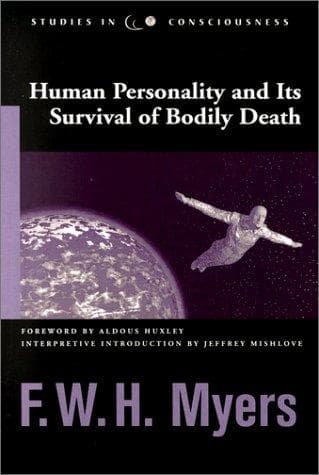
Human Personality and Its Survival of Bodily DeathMyers, F. W. H. (Frederic William Henry)
Religion
Human Personality and Its Survival of Bodily Death
Myers, F. W. H. (Frederic William Henry)
Immortality; Parapsychology; Personality
"Mr. Van R., of Utica," says Dr. Scripture on the authority of Gall, "at
the age of six years distinguished himself by a singular faculty for
calculating in his head. At eight he entirely lost this faculty, and
after that time he could calculate neither better nor faster than any
other person. _He did not retain the slightest idea of the manner in
which he performed his calculations in childhood._"
Turning now to the stupid or uneducated prodigies, Dase alone seems to
have retained his power through life. Colburn and Mondeux, and
apparently Prolongeau and Mangiamele, lost their gift after childhood.
On the whole the ignorant prodigies seldom appear to have been conscious
of any continuous logical process, while in some cases the separation of
the supraliminal and subliminal trains of thought must have been very
complete. "Buxton would talk freely whilst doing his questions, that
being no molestation or hindrance to him."[29] Fixity and clearness of
inward visualisation seems to have been the leading necessity in all
these achievements; and it apparently mattered little whether the mental
blackboard (so to say) on which the steps of the calculation were
recorded were or were not visible to the mind's eye of the supraliminal
self.
I have been speaking only of visualisation; but it would be interesting
if we could discover how much actual mathematical insight or
inventiveness can be subliminally exercised. Here, however, our
materials are very imperfect. From Gauss and Ampère we have, so far as I
know, no record. At the other end of the scale, we know that Dase
(perhaps the most successful of all these prodigies) was singularly
devoid of mathematical grasp. "On one occasion Petersen tried in vain
for six weeks to get the first elements of mathematics into his head."
"He could not be made to have the least idea of a proposition in Euclid.
Of any language but his own he could never master a word." Yet Dase
received a grant from the Academy of Sciences at Hamburg, on the
recommendation of Gauss, for mathematical work; and actually in twelve
years made tables of factors and prime numbers for the seventh and
nearly the whole of the eighth million,--a task which probably few men
could have accomplished, without mechanical aid, in an ordinary
lifetime. He may thus be ranked as the only man who has ever done
valuable service to Mathematics without being able to cross the Ass's
Bridge.
Public-domain text, read in full here on John Shaqi.
Reviews
Reviews
No reviews yet
Be the first to share your thoughts on this work.
Elsewhere in the archive
Join the Discussion
Join the discussion
Sign in to leave a comment or review.
Sign InorCreate an account