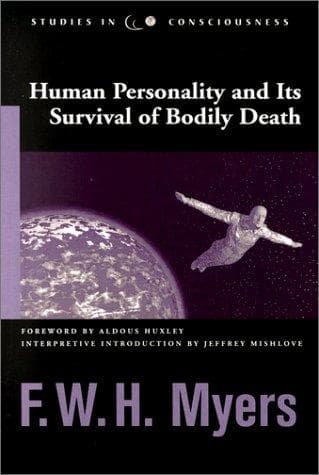
Human Personality and Its Survival of Bodily DeathMyers, F. W. H. (Frederic William Henry)
Religion
Human Personality and Its Survival of Bodily Death
Myers, F. W. H. (Frederic William Henry)
Immortality; Parapsychology; Personality
And thirdly, in some of these instances we see the man of genius
achieving spontaneously, and unawares, much the same result as that
which is achieved for the hypnotic subject by deliberate artifice. For
he is in fact co-ordinating the waking and the sleeping phases of his
existence. He is carrying into sleep the knowledge and the purpose of
waking hours;--and he is carrying back into waking hours again the
benefit of those profound assimilations which are the privilege of
sleep. Hypnotic suggestion aims at co-operations of just this kind
between the waking state in which the suggestion, say, of some
functional change, is planned and the sleeping state in which that
change is carried out,--with benefit persisting anew into waking life.
The hypnotic trance, which is a _developed_ sleep, thus accomplishes for
the ordinary man what ordinary sleep accomplishes for the man of genius.
The coming chapters on Sleep and Hypnotism will illustrate this point
more fully. But I may here anticipate my discussion of _dreams_ by
quoting one instance where dreams, self-suggested by waking will,
formed, as one may say, an integral element in distinguished genius.
The late Robert Louis Stevenson, being in many ways a typical man of
genius, was in no way more markedly gifted with that integrating
faculty--that increased power over all strata of the personality--which
I have ascribed to genius, than in his relation to his dreams (see "A
Chapter on Dreams" in his volume _Across the Plains_). Seldom has the
essential analogy between dreams and inspiration been exhibited in such
a striking way. His dreams had always (he tells us) been of great
vividness, and often of markedly _recurrent_ type. But the point of
interest is that, when he began to write stories for publication, the
"little people who managed man's internal theatre" understood the change
as well as he.
When he lay down to prepare himself for sleep, he no longer sought
amusement, but printable and profitable tales; and after he had
dozed off in his box-seat, his little people continued their
evolutions with the same mercantile designs.... For the most part,
whether awake or asleep, he is simply occupied--he or his little
people--in consciously making stories for the market....
The more I think of it, the more I am moved to press upon the world
my question: "Who are the Little People?" They are near connections
of the dreamer's, beyond doubt; they share in his financial worries
and have an eye to the bank book; they share plainly in his
training; ... they have plainly learned like him to build the
scheme of a considerate story and to arrange emotion in progressive
order; only I think they have more talent; and one thing is beyond
doubt,--they can tell him a story piece by piece, like a serial,
and keep him all the while in ignorance of where they aim....
Public-domain text, read in full here on John Shaqi.
Reviews
Reviews
No reviews yet
Be the first to share your thoughts on this work.
Elsewhere in the archive
Join the Discussion
Join the discussion
Sign in to leave a comment or review.
Sign InorCreate an account