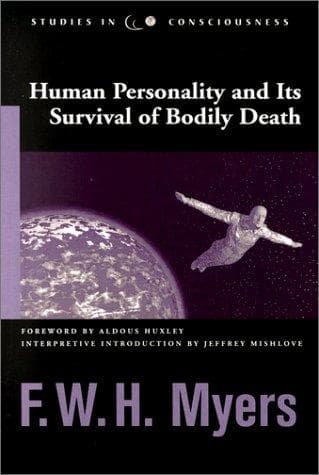
Human Personality and Its Survival of Bodily DeathMyers, F. W. H. (Frederic William Henry)
Religion
Human Personality and Its Survival of Bodily Death
Myers, F. W. H. (Frederic William Henry)
Immortality; Parapsychology; Personality
De Musset writes, "On ne travaille pas, on écoute, c'est comme un
inconnu qui vous parle à l'oreille."
Lamartine says, "Ce n'est pas moi qui pense; ce sont mes idées qui
pensent pour moi."
Rémy de Gourmont: "My conceptions rise into the field of consciousness
like a flash of lightning or like the flight of a bird."
M. S. writes: "In writing these dramas I seemed to be a spectator at the
play; I gazed at what was passing on the scene in an eager, wondering
expectation of what was to follow. And yet I felt that all this came
from the depth of my own being."
Saint-Saens had only to listen, as Socrates to his Dæmon; and M. Ribot,
summing up a number of similar cases, says: "It is the unconscious which
produces what is vulgarly called inspiration. This condition is a
positive fact, accompanied with physical and psychical characteristics
peculiar to itself. Above all, it is impersonal and involuntary, it acts
like an instinct, when and how it chooses; it may be wooed, but cannot
be compelled. Neither reflection nor will can supply its place in
original creation.... The bizarre habits of artists when composing tend
to create a special physiological condition,--to augment the cerebral
circulation in order to provoke or to maintain the unconscious
activity."
In what precise way the cerebral circulation is altered we can hardly at
present hope to know. Meantime a few psychological remarks fall more
easily within our reach.
In the first place, we note that a very brief and shallow submergence
beneath the conscious level is enough to infuse fresh vigour into
supraliminal trains of thought. Ideas left to mature unnoticed for a few
days, or for a single night, seem to pass but a very little way beneath
the threshold. They represent, one may say, the first stage of a process
which, although often inconspicuous, is not likely to be
discontinuous,--the sustenance, namely, of the supraliminal life by
impulse or guidance from below.
In the second place, we see in some of these cases of deep and fruitful
_abstraction_ a slight approach to duplication of personality. John
Stuart Mill, intent on his _Principles of Logic_, as he threaded the
crowds of Leadenhall Street, recalls certain morbid cases of hysterical
_distraction_;--only that with Mill the process was an integrative one
and not a dissolutive one--a gain and not a loss of power over the
organism.
Public-domain text, read in full here on John Shaqi.
Reviews
Reviews
No reviews yet
Be the first to share your thoughts on this work.
Elsewhere in the archive
Join the Discussion
Join the discussion
Sign in to leave a comment or review.
Sign InorCreate an account