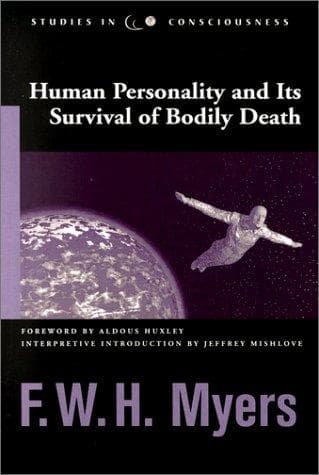
Human Personality and Its Survival of Bodily DeathMyers, F. W. H. (Frederic William Henry)
Religion
Human Personality and Its Survival of Bodily Death
Myers, F. W. H. (Frederic William Henry)
Immortality; Parapsychology; Personality
If the man of Genius be, as I have urged, on the whole the completest
type of humanity, and if the sensitive's special gift be in itself one
of the most advanced forms of human faculty, ought not the inspirations
of genius to bring with them flashes of supernormal knowledge as
intimate as those which the sensitive--perhaps in other respects a
commonplace person--from time to time is privileged to receive?
Some remarkable instances of this kind undoubtedly do exist. The most
conspicuous and most important of all cannot, from motives of reverence,
be here discussed. Nor will I dwell upon other founders of religions, or
on certain traditional saints or sages. But among historical characters
of the first mark the names of Socrates and of Joan of Arc are enough to
cite. I believe that the monitions of the Dæmon of Socrates--the
subliminal self of a man of transcendent genius--have in all probability
been described to us with literal truth: and did in fact convey to that
great philosopher precisely the kind of telæsthetic or precognitive
information which forms the sensitive's privilege to-day. We have thus
in Socrates the ideal unification of human powers.
It must, however, be admitted that such complete unification is not the
general rule for men of genius; that their inspirations generally stop
short of telepathy or of telæsthesia. I think we may explain this
limitation somewhat as follows. The man of genius is what he is by
virtue of possessing a readier communication than most men possess
between his supraliminal and his subliminal self. From his subliminal
self, he can only draw what it already possesses; and we must not assume
as a matter of course that the subliminal region of any one of us
possesses that particular sensitivity--that specific transparency--which
can receive and register _definite facts_ from the unseen. _That_ may be
a gift which stands as much alone--in independence of other gifts or
faculties--in the subliminal region as, say, a perfect musical ear in
the supraliminal. The man of genius may draw much from those hidden
wells of being without seeing reflected therein any actual physical
scene in the universe beyond his ordinary ken.
And yet neither must we hastily assume that because the man of genius
gets no _definite_ impression of a world beyond our senses he does not
therefore get any _true_ impression, which is all his own.
I believe, on the contrary, that true, though vague, impressions of a
world beyond the range of sense are actually received--I do not say by
all men of genius, but by men of genius of certain types.[37]
Public-domain text, read in full here on John Shaqi.
Reviews
Reviews
No reviews yet
Be the first to share your thoughts on this work.
Elsewhere in the archive
Join the Discussion
Join the discussion
Sign in to leave a comment or review.
Sign InorCreate an account