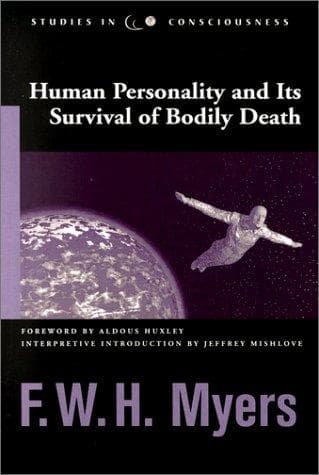
Human Personality and Its Survival of Bodily DeathMyers, F. W. H. (Frederic William Henry)
Religion
Human Personality and Its Survival of Bodily Death
Myers, F. W. H. (Frederic William Henry)
Immortality; Parapsychology; Personality
A dim but genuine consciousness of the spiritual environment; that (it
seems) is the degree of revelation which artistic or philosophic genius
is capable of conferring. Subliminal uprushes, in other words, so far as
they are intellectual, tend to become _telæsthetic_. They bring with
them indefinite intimations of what I hold to be the great truth that
the human spirit is essentially capable of a deeper than sensorial
perception, of a direct knowledge of facts of the universe outside the
range of any specialised organ or of any planetary view.
But this conclusion points the way to a speculation more important
still. Telæsthesia is not the only spiritual law, nor are subliminal
uprushes affairs of the intellect alone. Beyond and above man's innate
power of world-wide perception, there exists also that universal link of
spirit with spirit which in its minor earthly manifestations we call
telepathy. Our submerged faculty--the subliminal uprushes of genius--can
expand in that direction as well as in the direction of telæsthesia.
The emotional content, indeed, of those uprushes is even profounder and
more important than the intellectual;--in proportion as Love and
Religion are profounder and more important than Science or Art.
That primary passion, I repeat, which binds life to life, which links us
both to life near and visible and to life imagined but unseen;--_that_
is no mere organic, no mere planetary impulse, but the inward aspect of
the telepathic law. Love and religion are thus _continuous_; they
represent different phases of one all-pervading mutual gravitation of
souls. The flesh does not conjoin, but dissever; although through its
very severance it suggests a shadow of the union which it cannot bestow.
We have to do here neither with a corporeal nor with a purely human
emotion. Love is the energy of integration which makes a Cosmos of the
Sum of Things.
But here there is something of controversy to traverse before a revived
Platonic conception of love can hope to be treated by the physiologist
as more than a pedantic jest. And naturally so; since there is no
emotion subliminal over so wide a range of origin,--fed so obscurely by
"all thoughts, all passions, all delights,"--and consequently so
mysterious even to the percipient himself. At one end of its scale love
is based upon an instinct as primitive as the need of nutrition; even if
at the other end it becomes, as Plato has it, the ἑρμεὑον καἱ
διαπορθμεὑον "the Interpreter and Mediator between God and Man." The
controversy as to the planetary or cosmical scope of the passion of Love
is in fact central to our whole subject.
Public-domain text, read in full here on John Shaqi.
Reviews
Reviews
No reviews yet
Be the first to share your thoughts on this work.
Elsewhere in the archive
Join the Discussion
Join the discussion
Sign in to leave a comment or review.
Sign InorCreate an account