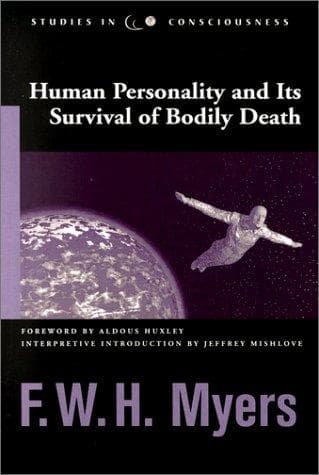
Human Personality and Its Survival of Bodily DeathMyers, F. W. H. (Frederic William Henry)
Religion
Human Personality and Its Survival of Bodily Death
Myers, F. W. H. (Frederic William Henry)
Immortality; Parapsychology; Personality
There is at first, as in every virulent malady, a period of
incubation; the new idea passes and repasses in the vague reveries
of the enfeebled consciousness; then seems for a few days to have
disappeared and to leave the mind to recover from its passing
trouble. But the idea has done its work below the surface; it has
become strong enough to shake the body; and to provoke movements
whose origin lies outside the primary consciousness. What is the
surprise of a sensible man when he finds himself piteously
returning beneath the windows of his charmer, whither his wandering
feet have taken him without his knowledge;--or when in the midst of
his daily work he hears his lips murmuring perpetually the
well-known name!... Such is passion in its reality; not as
idealised by fantastic description, but reduced to its essential
psychological characteristics. (_L'Automatisme Psychologique_, p.
466.)
On the other side I will appeal to Plato himself, giving a brief sketch
merely of one of the leading passages (_Symposium_, 192-212) where the
Platonic conception of love is set forth.[38]
Plato begins by recognising, as fully as pessimist or cynic could do,
the absolute inadequacy of what is called on earth the satisfaction of
this profound desire. Lovers who love aright will feel that no physical
nearness can content them, but what _will_ content them they cannot say.
"Their soul," says Plato, "is manifestly desiring something else; and
what it is she cannot tell, only she darkly prophesies thereof and
guesses it from afar. But if Hephæstus with his forging fire were to
stand beside that pair and say: 'Is this what ye desire--to be wholly
one? to be together by night and day?--for I am ready to melt you
together and to make you grow in one, so that from two ye shall become
one only, and in this life shall be undivided, and dying shall die
together, and in the underworld shall be a single soul';--there is no
lover who would not eagerly accept the offer, and acknowledge it as the
expression of the unknown yearning and the fulfilment of the ancient
need." And through the mouth of Diotima, Plato insists that it is an
unfailing sign of true love that its desires are _for ever_; nay, that
love may be even defined as the desire of the _everlasting_ possession
of the good. And in all love's acts he finds the impress of man's
craving for immortality,--for immortality whose only visible image for
us on earth is the birth of children to us as we ourselves decay,--so
that when the slow self-renewal of our own everchanging bodies has worn
out and ceased, we may be renewed in brighter, younger bodies which we
desire to be born to us from whomsoever we find most fair. "And then,"
says Plato, rising, as ever, from visible to invisible things, "if
active _bodies_ have so strong a yearning that an endless series of
lovely images of themselves may constitute, as it were, an earthly
Public-domain text, read in full here on John Shaqi.
Reviews
Reviews
No reviews yet
Be the first to share your thoughts on this work.
Elsewhere in the archive
Join the Discussion
Join the discussion
Sign in to leave a comment or review.
Sign InorCreate an account