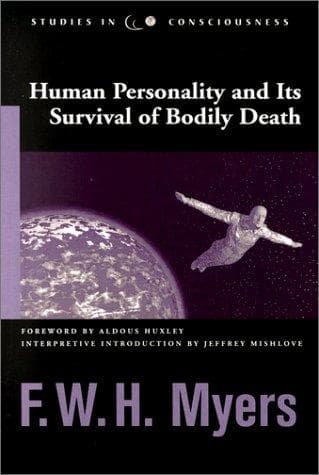
Human Personality and Its Survival of Bodily DeathMyers, F. W. H. (Frederic William Henry)
Religion
Human Personality and Its Survival of Bodily Death
Myers, F. W. H. (Frederic William Henry)
Immortality; Parapsychology; Personality
It will give clearness to the question in dispute if I quote here a
strong expression of each view in turn. For the physiological or
materialist conception of the passion of love,--where love's subliminal
element is held to be of the organic type,--set forth in no light or
cynical spirit, but with the moral earnestness of a modern Lucretius, I
can turn to no better authority than Professor Pierre Janet. The passage
which follows is no mere _boutade_ or paradox; it is a kind of
culminating expression of the theory which regards the supraliminal man
as the normal man, and distrusts all deep disturbance of his accustomed
psychical routine.
It is commonly said that love is a passion to which man is always
liable, and which may surprise him at any moment of his life from
15 to 75. This does not seem to me accurate; and a man is not
throughout all his life and at every moment susceptible of falling
in love (_de devenir amoureux_). When a man is in good physical and
moral health, when he has easy and complete command of all his
ideas, he may expose himself to circumstances the most capable of
giving rise to a passion, but he will not feel it. His desires will
be reasonable and obedient to his will, leading the man only so far
as he wishes to go, and disappearing when he wishes to be rid of
them. On the other hand, if a man is morally below the mark
(_malade au moral_),--if in consequence of physical fatigue or
excessive intellectual work, or of violent shocks and prolonged
sorrow, he is exhausted, melancholy, distracted, timid, incapable
of controlling his ideas,--in a word, _depressed_,--then he will
fall in love, or receive the germ of some kind of passion, on the
first and most trivial occasion.... The least thing is then enough;
the sight of some face, a gesture, a word, which previously would
have left us altogether indifferent, strikes us, and becomes the
starting point of a long amorous malady. Or more than this, an
object which had made no impression on us, at a moment when our
mind was healthier and not capable of inoculation, may have left in
us some insignificant memory which reappears in a moment of morbid
receptivity. That is enough; the germ is sown in a favourable soil;
it will develop itself and grow.
Public-domain text, read in full here on John Shaqi.
Reviews
Reviews
No reviews yet
Be the first to share your thoughts on this work.
Elsewhere in the archive
Join the Discussion
Join the discussion
Sign in to leave a comment or review.
Sign InorCreate an account