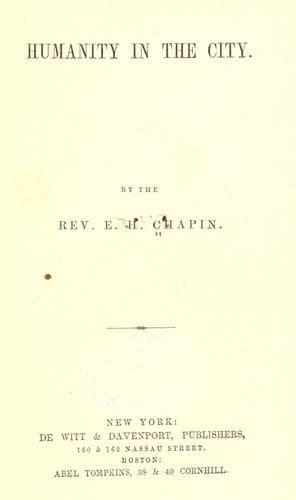
Sermons, American; Universalist Church of America -- Sermons
In the first place, these words suggest the relations of _Use_ and
_Help_ between Man and Machinery. Upon surveying these numerous and
complicated instruments, the thought that most readily occurs, perhaps,
is that of the _necessity_ of machinery. The very first step that man
takes, out of the condition of infant weakness and animal rudeness, must
be accomplished by the aid of some implement. He alone, of all beings
upon the face of the earth, is obliged to _invent_, and is capable of
endless invention. The necessity for this springs out, and is a prophecy
of, his destiny. The moment he was seen fashioning the first tool,
however imperfect, that moment was indicated the difference between
himself and the brute, and the control he was destined to gain over the
world about him. To fulfil this destiny, he confronts nature with naked
hands; and yet, there is the earth to plough, the harvest to reap, the
torrent to bridge, the ocean to cross; there are all the results to
achieve which constitute the difference between the primitive man, and
the civilization of the nineteenth century. The Machine, then--the agent
which links the gratification to the want--is born of necessity. But we
must make a distinction between those instruments which are positively
essential, and those, for instance, which merely answer the demands of
luxury or indolence.
And this brings up the question of the _comparative_ uses of
Machinery--the foremost place being assigned to those implements which
are absolutely indispensable to man's existence upon the earth. But
between this absolute degree, and that of frivolous invention, there are
countless grades of utility. And the question of usefulness must be
decided according to the _standard_ of utility which we apply. If bare
subsistence is assumed to be the end of man upon the earth, most of our
modern inventions are useless. We can travel without a locomotive, and
procure a meal without a cooking-range. The moment we rise above the
grossest conception of human existence, the test of usefulness becomes
enlarged, and we can make a safe decision upon whatever increases man's
comfort, adds to his ability, or inspires his culture. In this way, new
things _become_ indispensable. That which was not necessary _a priori_,
_is_ necessary now, in a fresh stage of development, and in connection
with circumstances that have sprung up and formed around it. That which
was not necessary to man the savage, living on roots and raw fish, is
necessary to man the civilized, with new possibilities opening before
him, and new faculties unfolded within him. The printing-press was not
absolutely necessary to Nimrod, or to Julius Caesar, but is it not
absolutely necessary now? Strike it out of existence to-day, and what
would be the condition of the world to-morrow? You would have to tear
away with it all that has grown up around it, and become assimilated to
it--the textures of the world's growth for three hundred years. Paul
Public-domain text, read in full here on John Shaqi.
Reviews
Reviews
No reviews yet
Be the first to share your thoughts on this work.
Join the Discussion
Join the discussion
Sign in to leave a comment or review.
Sign InorCreate an account