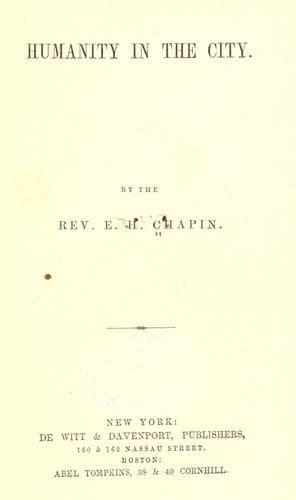
Sermons, American; Universalist Church of America -- Sermons
elevated above the imperative wants of existence. It is no proof of the
disadvantages of machinery, therefore, to say that it ministers to
something beside absolute bodily need, and delivers man from a slow and
exhausting drudgery. So far as it helps us to control nature, and
increases the facilities of human intercourse, and diffuses general
comfort and elegance, and affords a respite from incessant physical
toil, so far it is an agent and a sign of progress.
But, it may be said again, that it is the agent of a selfish and
exclusive power, enriching a few and injuring many. And it cannot be
denied that grave problems grow out of the relations between Machinery
and the laboring classes. Every little while, some new invention is
thrust forward, which takes a portion of labor out of the hands of flesh
and transfers it to hands of iron. It is not enough to say that mankind
in general is benefited by these inanimate agents, which do the work of
the world so much more rapidly and powerfully. This may answer as an
argument against a monopoly of any one kind of mechanical force. It may
be a reason for using cars instead of steamboats, and balloons rather
than railroads. The general good must be advanced, whatever the damage
to private interests. But the present case brings up the question
whether machinery is a general good at all; whether the effect of its
introduction into almost every department of labor, will not be felt in
the destitution of millions. And, upon this point, I observe, that, like
all other great revolutions, the immediate effect may be such as has
been suggested. But the final result will be beneficial, and such a
result may be traced out even now. For instance, this clogging of old
departments of labor will precipitate men upon fresh ones, and upon
those that have been too much neglected. It will tend to introduce woman
to branches of industry perfectly suited to her, but which have been too
exclusively occupied by the other sex, and to turn the attention of
robust men to those great fields of productive toil which are as yet but
little improved. It may drive them from the dependence, the crowded
competition, the unwholesome life of the city, into the broad fields and
open air and the sovereignty of the soil. And if this immense intrusion
of machinery has only this result, of equalizing the balance against
production, we shall have one solution of the problem. And there will be
another solution, if this phalanx of mechanism shall lift the mass of
men above the occasions of coarse material drudgery into other
activities, which doubtless will be thrown open, and shall allow more
leisure for spiritual culture. But in this, and all other great
questions affecting human welfare, I throw myself back, finally, upon
the tokens of Providential Design. The world moves forward, not
backward; and the great developments of time are for good, not evil. By
machinery, man proceeds with his dominion over nature. He assimilates it
Public-domain text, read in full here on John Shaqi.
Reviews
Reviews
No reviews yet
Be the first to share your thoughts on this work.
Join the Discussion
Join the discussion
Sign in to leave a comment or review.
Sign InorCreate an account