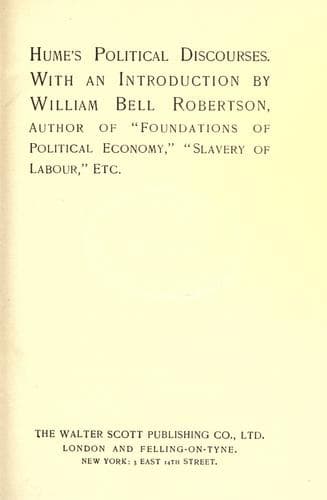
When the people have emerged ever so little from a savage state, and
their numbers have increased beyond the original multitude, there
must immediately arise an inequality of property; and while some
possess large tracts of land, others are confined within narrow
limits, and some are entirely without any landed property. Those who
possess more land than they can labour employ those who possess none,
and agree to receive a determinate part of the product. Thus
the landed interest is immediately established; nor is there any
settled government, however rude, in which affairs are not on this
footing. Of these proprietors of land, some must presently discover
themselves to be of different tempers from others; and while one would
willingly store up the product of his land for futurity, another
desires to consume at present what should suffice for many years. But
as the spending a settled revenue is a way of life entirely without
occupation, men have so much need of somewhat to fix and engage them,
that pleasures, such as they are, will be the pursuit of the greatest
part of the landholders, and the prodigals amongst them will always
be more numerous than the misers. In a state, therefore, where there
is nothing but a landed interest, as there is little frugality, the
borrowers must be very numerous, and the rate of interest must hold
proportion to it. The difference depends not on the quantity of money,
but on the habits and manners which prevail. By this alone the demand
for borrowing is increased or diminished. Were money so plentiful as
to make an egg be sold for sixpence, so long as there are only landed
gentry and peasants in the state, the borrowers must be numerous and
interest high. The rent for the same farm would be heavier and more
bulky, but the same idleness of the landlord, with the higher prices of
commodities, would dissipate it in the same time, and produce the same
necessity and demand for borrowing.
Nor is the case different with regard to the second circumstance which
we proposed to consider—viz., the great or little riches to supply
this demand. This effect also depends on the habits and ways of living
of the people, not on the quantity of gold and silver. In order to
have in any state a great number of lenders, it is not sufficient nor
requisite that there be great abundance of the precious metals. It is
only requisite that the property or command of that quantity which is
in the state, whether great or small, should be collected in particular
hands, so as to form considerable sums, or compose a great moneyed
interest. This begets a number of lenders and sinks the rate of usury;
and this, I shall venture to affirm, depends not on the quantity
of specie, but on particular manners and customs, which make the specie
gather into separate sums or masses of considerable value.
Public-domain text, read in full here on John Shaqi.
Reviews
Reviews
No reviews yet
Be the first to share your thoughts on this work.
Join the Discussion
Join the discussion
Sign in to leave a comment or review.
Sign InorCreate an account