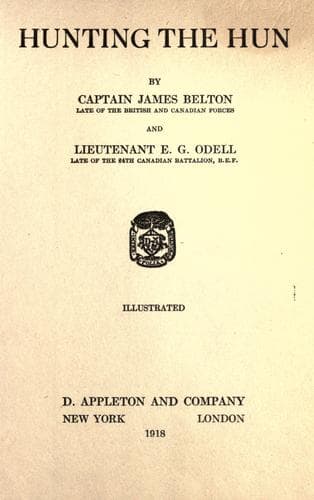
World War, 1914-1918 -- Personal narratives, Canadian
It was with a great sigh of relief that we perceived our escorts, two
small torpedo destroyers, steaming in our direction. They were soon
circling around us, and from that time onward everyone on board carried
life belts around with them, ready to put on at a moment's notice.
It was not long before we sighted land, and later on we docked at
Plymouth. The same evening I was in London, and was an eyewitness that
night of a Zeppelin raid.
Few people on this side of the Atlantic realise the nature of a
Zeppelin raid.
I can scarcely describe the horror I felt as the bombs began to descend
on their errand of destruction and murder. The searchlights began to
hunt the air for signs of the airships, and soon we heard the sharp
reports of our anti-aircraft guns along the Thames and also the big
guns at London Bridge.
The roar of the guns was terrible, but nowhere did I see any fear shown
by the populace. Children cried out, but no one could blame them for
that. The streets were weirdly dark, and with the shaded street lamps
and the shrill whistle of the taxis everything seemed to be mysterious.
We could not see the airships. They were so high up in the air that we
could not even see a speck in the sky.
All at once the guns ceased to roar, and then the air raid was over.
Casualties were few. In one house, where a number of poor people had
taken shelter, the roof fell in and the building caught fire. Amongst
the killed was a young clergyman who had been preaching to the people
at this critical moment. At this house, the people had taken shelter in
the basement, which they thought was safer than their own homes.
I was very much impressed with an old lady who kept a fish and chip
shop. Her establishment had been partially destroyed. One-half of the
window had been blown out and on the other half of the window was
displayed a sign which read "Damn the Zeppelins. To Hell with the
Kaiser. Fish and Chips as Usual." This shows the spirit of the women of
Britain. You can't beat morale like that.
In this manner the Huns wage war, trying to weaken the morale of
the people. If they would consider for one moment the spirit of a
nation like England, who gave the dead crew of one of these destroyed
Zeppelins a military funeral, they would realise that a nation which
treats a dead enemy like this has a morale that can never be broken.
Incidents like the foregoing make the people more determined than ever
to push the war to a victorious and successful conclusion.
Public-domain text, read in full here on John Shaqi.
Reviews
Reviews
No reviews yet
Be the first to share your thoughts on this work.
Join the Discussion
Join the discussion
Sign in to leave a comment or review.
Sign InorCreate an account