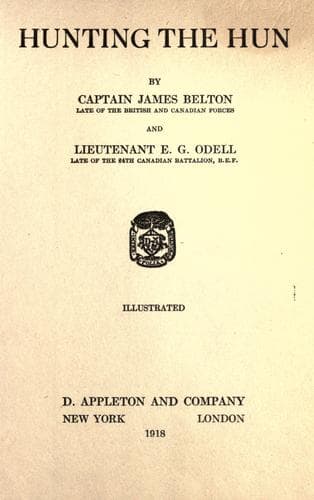
World War, 1914-1918 -- Personal narratives, Canadian
The night of the 14th we were relieved and retired to a series of
dugouts situated just beneath the railway track. These dugouts had
formerly been occupied by the Huns when they had held the ridge. The
idea was that if the Germans should counterattack we would immediately
get over the top of the railway embankment and make it our line of
resistance.
The dugout occupied by our company officers had evidently been a German
battalion headquarters, as it was fitted up with comfortable bunks
and had in the rear a beautiful kitchen garden in which all kinds of
vegetables were growing at one time. It was quite evident the Germans
had been living very luxuriously. About 6:30 the next evening, while we
officers were having our supper, a shell landed suddenly on the top of
the railway embankment. We thought that the Germans intended shelling
this point.
As we hastily rushed through the doorway into the open, each officer
blowing his whistle for the men to come out of the various dugouts
along the railway embankment, I noticed that a working party from the
22nd French Canadian Battalion instead of going under the bridge had
passed over the embankment. The Germans had directed their fire upon
this party, inflicting several casualties. They then started to shell
along the embankment, killing two brigade machine gun company men in
the next dugout to ours.
Later on I saw all my men located in the various shell holes. I then
took up my position alongside of my batman and stretcher bearer,
remaining with them until 3.00 in the morning. We were now so used to
the periodical shelling that we did not pay any attention to it. We all
felt like sleeping although it was exceedingly cold and rainy. Three
of us huddled close to one another for warmth, the stretcher bearer
lying next to me. He proved a most uncomfortable companion as he was
continually trying to rub his back against the stretcher. I had my
suspicions that I would soon be hunting something other than Huns.
CHAPTER V
HUNTING THE HUN
For three weeks my battalion practiced going over the tapes for an
attack on the Cite St. Laurent, a suburb of Lens. The tapes were laid
on the ground to represent the trenches held by the Germans. Various
coloured flags were placed at the corners of the assumed streets and
these were named as we would find the streets when we made our attack.
The church of the town was represented by a cross made of tape. Our
battalion frontage was some 300 yards, and at some places we were not
more than the same distance away from the Hun trench.
Public-domain text, read in full here on John Shaqi.
Reviews
Reviews
No reviews yet
Be the first to share your thoughts on this work.
Join the Discussion
Join the discussion
Sign in to leave a comment or review.
Sign InorCreate an account