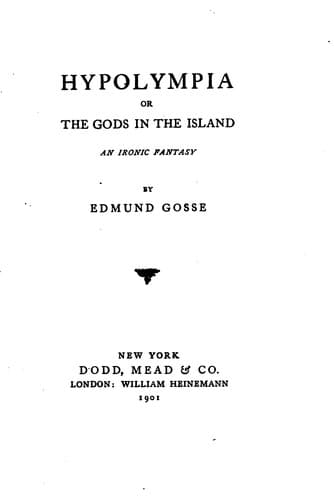
Hypolympia; Or, The Gods in the Island, an Ironic FantasyGosse, Edmund
Science
Hypolympia; Or, The Gods in the Island, an Ironic Fantasy
Gosse, Edmund
Gods, Greek -- Drama
So it appears. And you will suffer for it. For, stiff and blank as
you may determine to be, circumstances will overpower you. Under
their influences you will not be able to avoid becoming softer and
more redundant. But you will resist the process, I see, and you
will make it as painful as you can.
ARES.
You discuss my case with a cheerful candour, Aphrodite. Are you
sure of being happier yourself?
APHRODITE.
Not _sure_; but I have a reasonable confidence that I shall be
fairly contented. For I, at least, am supple, and I court the
influences which you think it a point of gallantry to resist.
ARES.
You will continue, I suppose, to make your main business the
stimulating and the guiding of the affections? Here I admit that
suppleness, as you call it, is in place.
APHRODITE.
Unfortunately, even here, immortality was no convenient prelude
to our present state. We did not, indeed, neglect the heart----
ARES.
If I forget all else, there must be events----
APHRODITE.
Alas! we loved so briefly and with so facile a susceptibility, that
I am tempted to ask myself whether in Olympus we really loved at all.
ARES [_with ardour_].
There, at least, memory supplies me with no sort of doubt----
APHRODITE [_coldly_].
Let us keep to generalities. Looking broadly at our experience, I
should say that the misfortune of the gods, as a preparation for
their mortality, was that in their deathless state the affections
fell at the foot of the tree, like these withered leaves. We should
have fastened the branches of life together in long elastic wires
of the thin-drawn gold of perdurable sentiment.
ARES.
The rapture, the violence, the hammering pulse, the bursting
heart,--I see no resemblance between these and the leaves that
flutter at our feet.
APHRODITE.
These leaves had their moment of vitality, when the sap rushed
through their veins, when their tissue was like a ripple of
sparkling emerald on the face of the smiling sky. But they could
not preserve their glow, and they are the more hopelessly dead
now, because they burned in their green fire so fiercely.
ARES.
We felt no shadow of coming disability strike across our pleasures.
APHRODITE.
No; but that was precisely what made our immortality such an ill
preparation for a brief existence on this island. In Olympus the
sentiment of yesterday was forgotten, and we realised the passion
of to-day as little as the caprice of to-morrow. Perhaps this
fragmentary tenderness was the real chastisement of our implacable
prosperity.
ARES [_in a very low voice_].
Can we not resume in this our exile, and with more prospect of
continuity, the emotions which were so agreeable in our former
state? So agreeable--although, as you justly say, too ephemeral
[_coming a little closer_]. Can you not teach us to moderate and
to prolong the rapture?
APHRODITE [_rising to her feet_].
Public-domain text, read in full here on John Shaqi.
Reviews
Reviews
No reviews yet
Be the first to share your thoughts on this work.
Join the Discussion
Join the discussion
Sign in to leave a comment or review.
Sign InorCreate an account