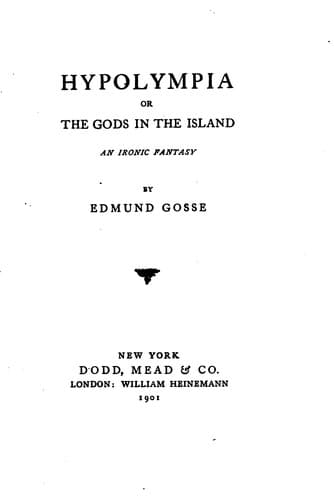
Hypolympia; Or, The Gods in the Island, an Ironic Fantasy — John Shaqi
Hypolympia; Or, The Gods in the Island, an Ironic FantasyGosse, Edmund
Science
Hypolympia; Or, The Gods in the Island, an Ironic Fantasy
Gosse, Edmund
Gods, Greek -- Drama
Ah! you followed the youths and maidens to the little temple of
our friend. Is it not beautiful?
HERMES.
It is hideous.
CIRCE.
Are you sure that it is a temple at all?
HERMES.
I confess that I was for a long time uncertain, but on the whole
I believe that it is.
APHRODITE.
But is it dedicated to me?
HERMES.
That is the disappointment.... It is best to tell you at once
that I see no evidence whatever that it is.
CIRCE.
I am very much disappointed.
APHRODITE.
I am very much relieved. But could you not gather from the
decoration of the interior to whom of us it is inscribed?
HERMES.
It is not decorated at all: whitewashed walls, wooden benches,
naked floors.
CIRCE.
But what is the nature of the sculpture?
HERMES.
I could see no sculpture, except a sort of black tablet, with
names upon it, and at the sides two of the youthful attendants of
Eros--those that have wings, indeed, but cannot rest. These were
exceedingly ill-carven in a kind of limestone. And I hardly like
to tell you what I found behind the altar----
APHRODITE.
I am not easily shocked. My poor worshippers sometimes demand a
very considerable indulgence.
CIRCE.
Nothing very ugly, I hope?
HERMES.
Yes; very ugly, and still more incomprehensible. But nothing that
could spring out of any misconception of the ritual of our friend.
No; I hardly like to tell you. Well, a gaunt painted figure, with
spines about the bleeding forehead----
APHRODITE.
Was it fastened to any symbol? Did you notice anything that
explained the horror of it?
HERMES.
No. I did not observe it very closely. As I was glancing at it,
the celebration or ritual, or whatever we are to call it, began,
and I withdrew to the door, not knowing what frenzy might seize
upon the worshippers.
APHRODITE.
There was a cannibal altar in Arcadia to Phoebus, so I have
heard. He instantly destroyed it, and scattered the ignorant
savages who had raised it.
HERMES.
There was a touch of desolate majesty about this figure. I fear
that it portrays some blighting Power of suffering or of grief.
[_He shudders._]
APHRODITE.
There are certainly deities of whom we knew nothing in Olympus.
Perhaps this is the temple of some Unknown God.
HERMES.
I admit that I thought, with this picture, and with their sinister
garments of black and of blue, and with the bareness and harshness
of the temple, that something might be combined which it would
give me no satisfaction to witness. I placed myself near the door,
where, in a moment, I could have regained the exquisite forest, and
the odour of this carpet of woodruff, and your enchanting society.
But nothing occurred to disconcert me. After genuflexions and
liftings of the voice----
APHRODITE.
What was the object of these?
HERMES.
Public-domain text, read in full here on John Shaqi.
Reviews
Reviews
No reviews yet
Be the first to share your thoughts on this work.
Join the Discussion
Join the discussion
Sign in to leave a comment or review.
Sign InorCreate an account