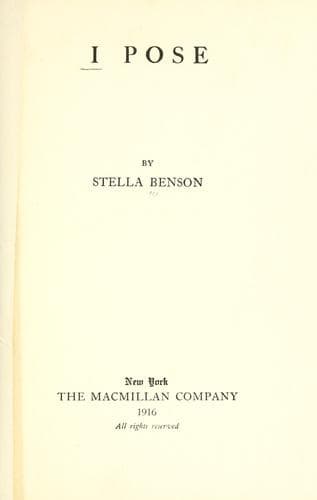
London (England) -- Fiction; Satire; Suffragists -- Fiction
There was a moon, and there were stars standing aloof in the sky; and
there were many lights about the garden. There were shrill brass voices
everywhere, and the band was playing that tune of resigned
sentimentality, “My Old Kentucky Home.”
The suffragette felt slightly drunk. She had had a day of emotions, and
it was an unusual and intoxicating experience for her to find her
emotions escaping from the iron bound cask in which she kept them. She
felt totally irresponsible, and when the priest came along, looking as
conceited as the moon, and as sentimentally benign as the stars, she
discovered a lunatic longing to tear the hat from his head and stamp
upon it, to make him look a fool, to prick his pride; not because of any
personal enmity—or so she thought—but because he seemed eternally on the
side of sanity and of yesterday, and barred the path of young and mad
modernity. She approached him.
The priest suddenly perceived in front of him a soul dangerously in need
of salvation.
“My dear young lady, I have been seeking an opportunity for a quiet chat
with you, yerce, yerce. Whatever you may think of me, I assure you that
I am not the hard and inhuman man you think me. I should be only too
thankful to be of service to you. Let us sit on that quiet seat, away
from the crowd.”
“It is good of you to risk contamination,” said the suffragette.
“My calling leads me among the publicans and sinners,” said the priest.
“It is not my business to divide the sheep from the goats.”
“Not your business, but your pleasure,” suggested the suffragette.
The priest stiffened.
“I wish you had not hardened your heart against my help,” he said.
“Believe me, I have every sympathy with a young and unprotected woman in
your position. I think sometimes life seems hard on the weaker sex,
yerce, yerce.”
“It is a great honour to be a woman,” said the suffragette. “Your God
certainly turns his back on the individual, but he is very just to the
mass. The day of women is just dawning.”
“There may be something in what you say,” observed the priest, feeling
that she was somehow erasing all that he had meant to say. “I am sure we
shall all be glad to see Woman come into her own. But....”
“Men may possess the past, but women have the future,” continued the
suffragette, who was certainly very much excited. “We have suddenly
found what you have lost—the courage of our convictions. The art of
being a fanatic seems to me to be the pivot of progress; but men have
lost, and women have caught that blessed disease.”
“I do not see how all this applies to the matter in hand,” said the
priest. “Unless you are trying to convey to me, by way of an excuse, the
craving which I am told possesses most women of your persuasion—the
craving for fame, the morbid wish to be talked about.”
Public-domain text, read in full here on John Shaqi.
Reviews
Reviews
No reviews yet
Be the first to share your thoughts on this work.
Elsewhere in the archive
Join the Discussion
Join the discussion
Sign in to leave a comment or review.
Sign InorCreate an account