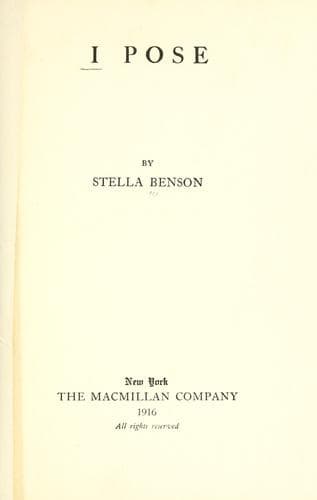
London (England) -- Fiction; Satire; Suffragists -- Fiction
“In what we do, we’re a poor argument for the Franchise. In what we are,
we’re the very best. It’s not possible for the community to be hit
without deserving it. It must look round and find out why it is hit—not
how. Punishment is no good to a smasher of windows. Any woman can see if
she’s wrong without punishment. If she thinks she’s right, punishment
can never alter her opinion.”
“Smashers must be punished. It would be impossible to allow even the
righteous to take the law into their own hands.”
“In whose hands should we leave it? In the hands of those who declare
themselves to be our enemies? A fair question from a woman never gets a
fair answer. Windows are smashed—not as an argument, but as a protest.”
“A protest strikes me as a futile thing. No one ever does anything that
looks unfair or tyrannical without being perfectly sure that was the
thing they meant to do. If a protest is successful it creates discord
without altering what is done. If it’s unsuccessful, it leaves you with
a high temperature and bruised hands, and what is gained by that?”
“Protest isn’t a thing you argue about,” said the suffragette. “It’s a
thing you do when you see red. You seem to think that men have the
monopoly of the last straw.”
“It is hard to believe that you have reached the last straw,” said
Samuel. “It is very hard for men to picture women as an oppressed race.
We are miles and miles away from each other. I can still think of a lot
of things to say, but I can’t say them without a moral megaphone. Shall
we call a draw?”
“Let’s,” said the suffragette, relaxing her militant expression. “Only
let me have the last word—a rather long one. Of one thing I am
certain—when we have the vote, men will see what a small gift it was,
and future generations will ask why it was grudged so bitterly. Only to
us who have fought for it and suffered for it, it will always seem high
and splendid—like a flag captured in battle....”
“The country is looking pretty just now, isn’t it?” said Mr. Samuel
Rust.
The gardener was standing at the window, watching the clipped yew bird
outside curtseying to the wind. He had been pathetically silent, like a
snubbed child, ever since he had consented to be a friend and not a
lover. His white keen face was a striking illustration of enthusiasm
damped. His jaw looked as if he were clenching his teeth on something
bitter. I think he was regretting the days when gold hair with a ripple
in it as laboured as the ripples in an old Master’s seascape, wide blue
eyes alight with matrimonial instinct, and the very red lips of a very
small mouth, were all that his heart needed.
And I wonder what the suffragette saw in his face that made her say in a
very non-militant voice, “Come, gardener.”
Public-domain text, read in full here on John Shaqi.
Reviews
Reviews
No reviews yet
Be the first to share your thoughts on this work.
Elsewhere in the archive
Join the Discussion
Join the discussion
Sign in to leave a comment or review.
Sign InorCreate an account